Paris schedule, local times and U.S. television
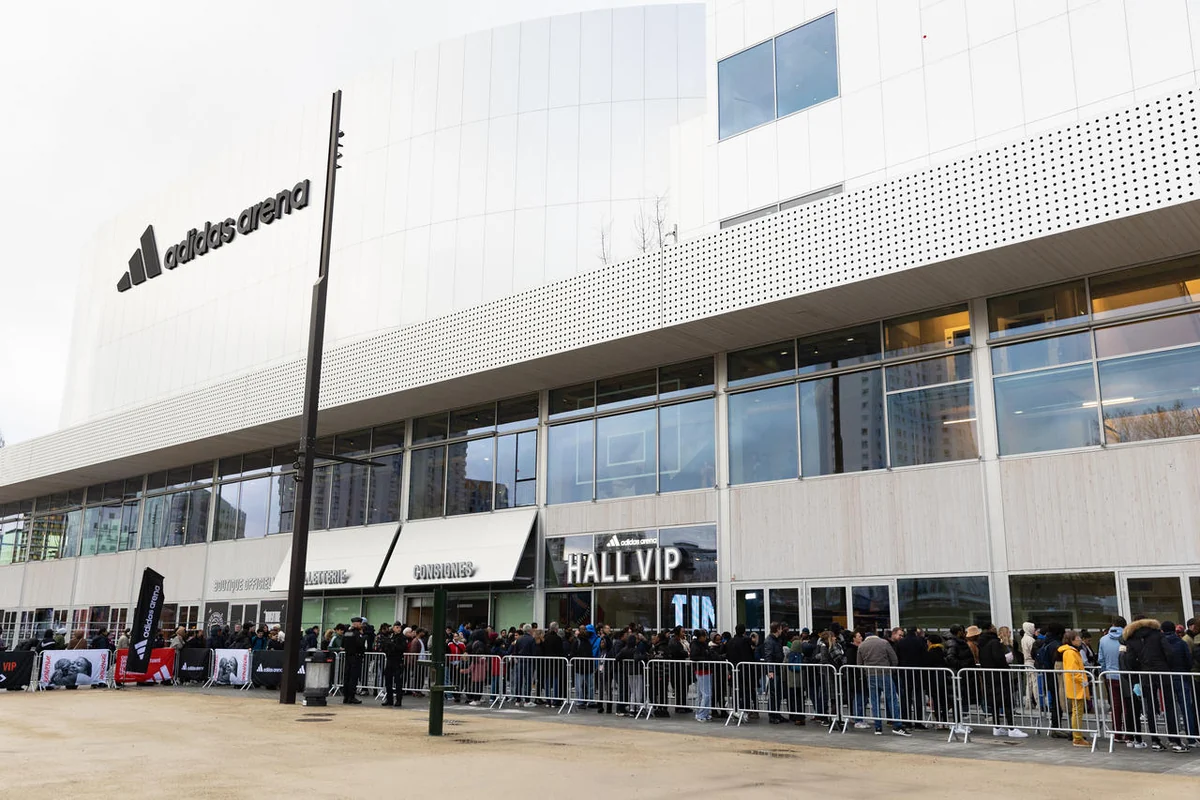
Oui-Play Paris brings South Carolina, Maryland, North Carolina and Oklahoma to the Adidas Arena on Monday, November 2, 2026. South Carolina–Maryland opens the women's doubleheader at noon Eastern on ESPN. North Carolina–Oklahoma follows at 2:30 p.m. Eastern on ESPN2. For a spectator in Paris, those are evening starts: 6 p.m. and 8:30 p.m. local time.
| Game, November 2 | U.S. Eastern | U.S. Central | Paris, CET | U.S. television |
|---|---|---|---|---|
| South Carolina vs. Maryland | Noon | 11 a.m. | 6 p.m. | ESPN |
| North Carolina vs. Oklahoma | 2:30 p.m. | 1:30 p.m. | 8:30 p.m. | ESPN2 |
These assignments were checked on October 30 against the latest ESPN season announcement and school schedules. The distinction between ESPN and ESPN2 matters. An earlier SEC announcement contained a broad prose reference to ESPN for the second game, while its detailed table said ESPN2. The newer October 26 announcement and North Carolina's current schedule agree on ESPN2.
Set two reminders if you want both games. A television tuned to the first channel does not automatically follow a doubleheader onto a second channel, and a recording programmed only for South Carolina–Maryland may not include the later contest. Check the matchup name in the on-screen guide rather than relying only on the event title.
ESPN says games are available through its app with an applicable subscription. That wording does not mean that every subscription carrying an ESPN brand unlocks every linear channel. Confirm ESPN and ESPN2 access in the service you actually use before tipoff. The season viewing guide provides broader context, but the two channel assignments above are the event-specific starting point.
The Paris conversion is attached to this date, not a permanent rule for every autumn week. On November 2 the city uses Central European Time, six hours ahead of Eastern Standard Time. Keep the location's time zone enabled when adding the game to a calendar, particularly if traveling between the United States and France.
Both tip times are scheduled starts. The second game also depends on the practical turnover between two games in one arena. Join the official coverage early and consult the school's live game entry if a television guide changes. The listed U.S. networks should not be read as a promise that the same player or subscription is available in every country.
These are regular-season openers, not a four-team tournament
Paris supplies a shared setting for two games, not a bracket that sends Monday's winners into a final. South Carolina plays Maryland; North Carolina plays Oklahoma. A win in the first game does not create a meeting with the winner of the second. That distinction matters when a ticket listing uses a broad event name and a promotional graphic puts all four programs together.
These are regular-season games. South Carolina's announcement identifies Maryland as its 2026–27 season opener, and the other schools' schedules place their Paris matchup after preseason exhibitions. The overseas location does not turn the games into practice sessions, and the absence of a tournament trophy does not make their results unofficial.
Exhibition scores and opening-night records are different things
Maryland and North Carolina provide a timely example. They played an October 24 exhibition in College Park, with Maryland winning 72–68. Both programs then travel to the same Paris doubleheader, but face different opponents. The exhibition gives viewers something concrete to examine; it does not mean Maryland enters the regular season with that win already in its official record.
The score also does not create a simple chain of predictions. Maryland beating North Carolina in an exhibition does not establish how either team will perform against South Carolina or Oklahoma. Different opponents change the matchups, help responsibilities and pressure on a rotation. Exhibition substitutions and competitive priorities may differ from the choices a coach makes when the first regular-season result is at stake.
Watch those choices rather than treating the word “opener” as a ceremonial label. Which group begins a close fourth quarter? Does a coach bring a starter back after an opponent changes the defensive matchup? Who handles the ball after a timeout? Those decisions can reveal early trust within a roster, even though one game will not settle the preferred lineup for the entire winter.
These are nonconference meetings. South Carolina and Oklahoma belong to the SEC, Maryland to the Big Ten, and North Carolina to the ACC; the Paris pairings cross those boundaries. They supply early evidence against substantial outside opposition rather than conference standings points. Their eventual value within a postseason résumé will depend on a season of results, not merely the location or reputation attached to the opener.
Enjoy the event as a doubleheader while keeping the two results separate. A viewer can compare how the teams execute in the same arena, but should not merge the games into a championship format that has not been scheduled.
South Carolina–Maryland is an immediate possession test
South Carolina–Maryland is more interesting as a possession-by-possession test than as a comparison of preseason winning margins. Maryland's recent exhibition against North Carolina offers a specific starting point: the Terrapins won the rebounding count 44–33 and produced 13 offensive rebounds to Carolina's six. Those numbers come from the official October 24 box score, not a forecast of what must happen in Paris.
Rebounding has to finish the defensive work
A possession does not end when a defense forces a difficult shot. Maryland's activity on the glass makes the next action worth watching: who makes first contact, who tracks the long rebound and whether a perimeter player helps secure the ball. Against a different opponent, the same responsibilities can become more demanding even if the first shot is well defended.
Nunu Agara supplied 22 points and 11 rebounds in that exhibition. Her production gives viewers a concrete player to follow around the lane and on the glass, without assuming she will receive identical opportunities against South Carolina. Watch whether a defensive matchup pulls a rebounder away from the basket and whether someone else fills the gap.
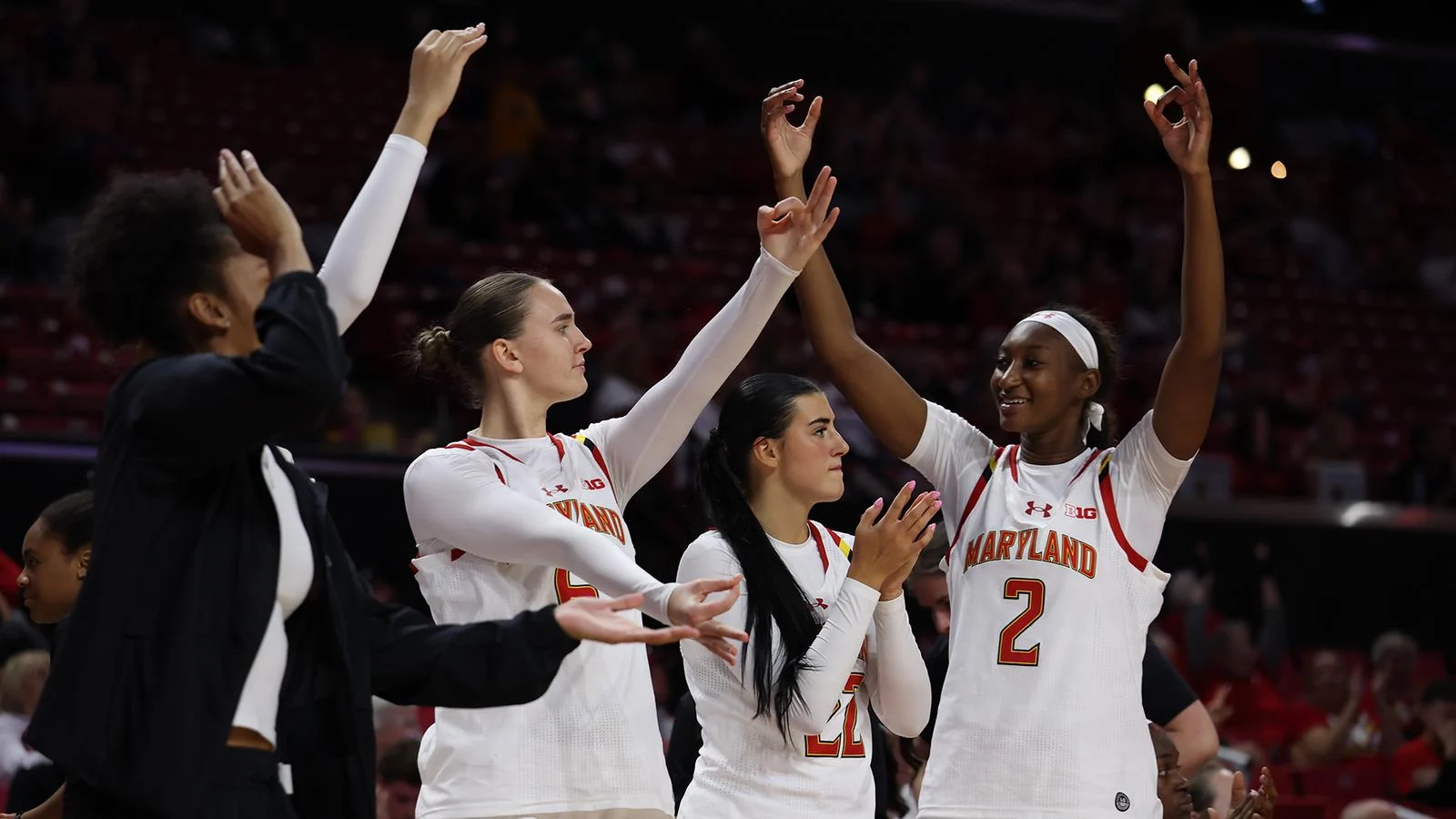
Free throws also shaped Maryland's last exhibition: 19 makes in 22 attempts, compared with North Carolina's seven in 14. Do not project an identical whistle in France. Instead, track what creates the attempts. Beating a defender to an advantageous spot, attacking an unsettled closeout and pursuing an offensive rebound are different routes to pressure at the line.
Watch the second action after the first option disappears
South Carolina arrives after a 113–34 exhibition win over Benedict. The school-authored recap lists Tessa Johnson and Jerzy Robinson with 17 points each and Joyce Edwards with 15. That spread provides context for the Gamecocks' roster discussion, but a large margin against one opponent cannot establish how a new matchup will unfold.
The useful question is what happens after Maryland takes away the first option. Can South Carolina move the defense again without wasting the remaining shot clock? Can Maryland respond to a second drive while still locating rebounders? A late, contested attempt may be a defensive success; an open shot after two quick reversals may be sound offense even if it misses.
Observe the bench groups as closely as the starters. The first substitutions can change ball pressure, passing angles and the number of players who need help near the rim. Paris will not settle every rotation decision, but it gives both staffs an immediate chance to see which combinations hold their structure when the opponent asks a second question.
North Carolina–Oklahoma offers a second, separate matchup
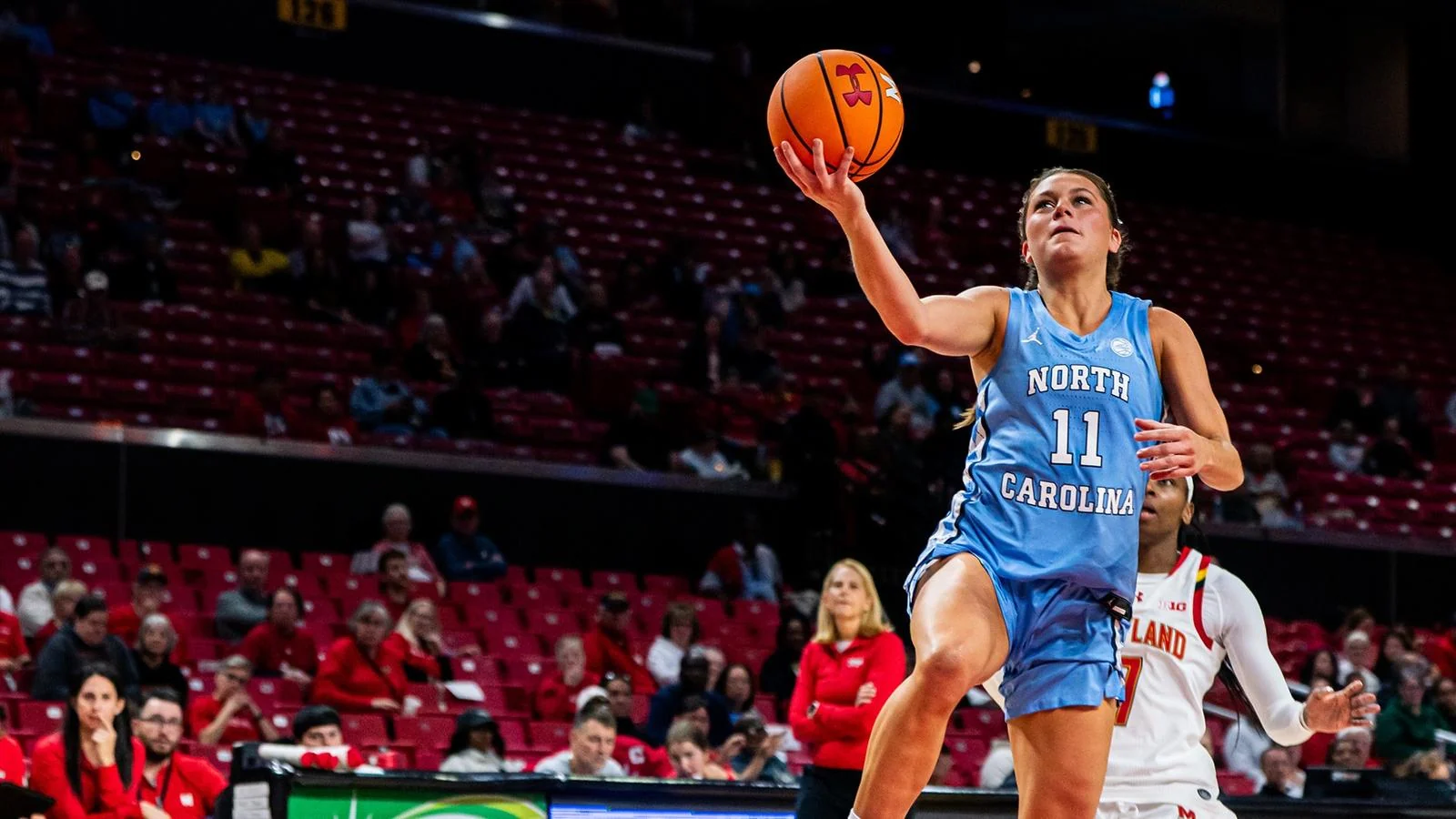
The later game deserves its own attention rather than being treated as an extension of South Carolina–Maryland. North Carolina comes out of a competitive exhibition in which freshman Kate Harpring scored 29 points on 12-of-22 shooting. Nyla Brooks added 14 points and three assists. Those figures establish useful names and questions for Paris without deciding who must lead the scoring in the opener.
Harpring's ability to create an attempt is one part of the evaluation. The next is what happens when an opponent sends help or changes the defender. Watch whether the ball moves early enough to create a second advantage and whether teammates remain involved after the initial action. A high individual total and a flowing team offense can coexist, but one does not automatically prove the other.
Oklahoma's most recent public evidence is very different. The Sooners beat Division II Southern Nazarene 124–39 in their October 25 exhibition. OU's recap lists Brooklyn Stewart with 21 points and Aaliyah Chavez with 14 points and nine assists. All 14 Sooners played, with 13 scoring. That is a picture of a wide exhibition rotation, not a reliable template for minutes in a tighter regular-season game.
The passing number is worth carrying into the opener as a question. Do the Sooners continue creating clean catches when defenders stay attached and the first lane closes? Does the receiver catch ready to shoot or have to reset the possession? A pass that arrives half a beat earlier can change whether a possession ends at the rim, at the line or with a contested jumper.
Watch the first sustained period with substitutes. A coach may use the opener to discover which combinations can defend and initiate offense together. A player who scores during a comfortable exhibition can face a different task when asked to bring the ball up against pressure or help on a drive without losing a shooter. The new assignment matters more than simply comparing her point total across the two games.
For North Carolina, the Maryland exhibition also offers a rebounding question to revisit. The Tar Heels do not need to reproduce every possession from College Park to show progress. Better first contact, clearer help responsibilities and an organized outlet after a stop would be more meaningful than a temporary lead built on unusually accurate shooting.
The teams' preseason results came against different opposition under different conditions. Resist turning 124–39 and 72–68 into a mathematical prediction. Use those games to choose what to watch, then let the Paris matchup supply its own evidence.
Going to the Adidas Arena
The venue is the Adidas Arena at Porte de la Chapelle, in Paris's 18th arrondissement. Use that building in your journey planner, not a general search for a Paris arena or an assumption based on another international sports event. The City of Paris venue listing gives the address as 56 Boulevard Ney.
Use the basketball venue and the local clock
The arena's official access guidance identifies Metro line 12 to Porte de la Chapelle and tram T3b as public-transport options. Check current service information on the day instead of treating a normal route description as a guarantee against disruption. Leave room for the walk to the entrance and security procedures before the opening game.
For an attendee, the important first-game time is 6 p.m. local. Noon is the U.S. Eastern broadcast time. Keep those references separate when arranging a meal, meeting another supporter or booking transport after the game. The second listed tip, 8:30 p.m., is not an announced finishing time for the evening.
A seat that helps you follow the game depends on what you enjoy watching. A sideline view can make spacing and weak-side movement easier to compare; a baseline angle can emphasize the depth of drives and help near the rim. Review the actual seating map and any restricted-view notation rather than treating a section label as enough information.
Check the actual ticket product before planning both games
The schools link to the Adidas Arena ticket outlet. Inspect the product's date, seat, included games and conditions before purchasing. A doubleheader title is useful context, but the specific ticket terms determine admission. Do not infer reentry, hospitality or team-event access from a general promotional description.
Older school announcements discussed special travel or VIP opportunities. Those historical offers are not evidence of current availability or a current price. If you want more than ordinary game admission, obtain the present package details directly from the school or operator and distinguish accommodation, transportation and optional events from the game ticket itself.
For both games, keep a usable ticket and the venue's current entry instructions available before reaching the building. Accessibility requirements deserve a direct check with the operator, particularly if a map does not explain the route from public transport to the assigned entrance. Paris is the setting for a basketball evening; planning around the actual venue and ticket lets the games remain the focus once you arrive.
Follow the doubleheader into the rest of November
Paris creates questions that the next few weeks can help answer. South Carolina and North Carolina are already scheduled to meet at the Ally Tipoff in Charlotte on November 8, at 5:30 p.m. Eastern on ESPN. That matchup is on the calendar regardless of the Paris results; it is not a final earned by winning the doubleheader.
Oklahoma's schedule then returns to Norman for Morgan State on November 8 and San Jose State on November 10. North Carolina later has November games against Texas Tech and Alabama in Orlando. Those changes of opponent and setting give viewers a way to test whether the things they notice in France persist when the travel, defensive matchups and rotation demands change.
Keep opening-day evidence in proportion
For each team, preserve one or two observations that can be checked again. Maryland's defensive possessions might be judged by whether the first stop is followed by a secure rebound. South Carolina's offense might be judged by how quickly it creates a second advantage after the first action is covered. North Carolina's ball movement and Oklahoma's distribution of creation provide similarly concrete questions.
Those observations are stronger when they describe an action rather than a mood. “The weak-side defender arrived before the roll pass” can be checked on film. “The team was not ready for Paris” can become a vague explanation for anything that went wrong. A long international trip is real context, but it does not prove why a particular shot missed or a rotation broke down.
Keep the final score attached to the circumstances, too. A close game with foul trouble can show how a staff handles an unfamiliar combination. A comfortable win can show whether the offense remains disciplined after the first substitutions. Neither result eliminates the need to see the team against another style of opponent.
Later in the season, the women's NET and selection guide explains how the wider résumé comes into view. There is no need to assign a permanent quadrant value or a bracket seed to an opening-night win before the opponents have developed their seasons. Paris supplies a result and an early test; the months ahead determine its larger context.
For now, the practical plan is straightforward: use noon and 2:30 p.m. Eastern for U.S. viewing, switch from ESPN to ESPN2 for the second game, or use 6 p.m. and 8:30 p.m. at the Adidas Arena. Then watch the possessions closely enough to carry useful basketball questions beyond the photographs and spectacle of opening night abroad.
Sign in with Google to join the discussion.