Which NCAA basketball record are you comparing?
NCAA basketball records belong to specific categories: men's or women's competition, division, statistic and counting period. A career rebounding mark, a single-game scoring explosion and a team's winning streak describe different achievements. This guide focuses on notable rebounds, steals, blocks and team streaks, with enough context to identify the record accurately.
The benchmarks come from the official record resources checked on October 14, 2026, including completed 2025–26 results. A current roster does not make a completed career total grow, and the year in a record table often names the season's ending year. Read those labels before comparing an older mark with a new milestone.
Division, competition and counting period
Start with competition. The NCAA publishes separate men's and women's books, along with separate divisional categories. Division I is a major part of the search interest, but it is not a synonym for all NCAA basketball. A Division III player can own a remarkable single-game mark without becoming the Division I record holder in that statistic.
Next identify the counting period. Career includes the eligible games in a player's college ledger; season isolates one campaign; game concerns one appearance. A rate such as rebounds per game supplies a denominator, while a total measures accumulation. Those differences can change the leader even when the underlying statistic stays the same.
Championship records create another boundary. An NCAA tournament-only table omits regular-season and conference-tournament games. A player who leads a championship category may have a different place in the career table, and neither claim contradicts the other. The official men's record hub and women's record hub make those separate ledgers accessible.
Association labels also remain necessary. An NAIA or junior-college achievement is part of college basketball history, but placing it in an NCAA table requires a category that actually includes it. Historical women's records can carry additional association boundaries. Retaining a label gives the achievement its proper identity instead of turning an impressive fact into an inaccurate comparison.
Finally, distinguish a verified record from a prediction that a record will never be broken. That prediction is commentary about the future. The number, holder and qualifying conditions are the factual claim. A fan can appreciate how demanding an achievement is without treating a confident headline as evidence that no later player or team could surpass it.
The selected examples below show why these distinctions matter on the court. Rebounding controls possessions, steals and blocks capture particular defensive events, and long streaks demand repeated team success. Each deserves its own explanation rather than being reduced to another version of a career scoring leaderboard.
Career rebounding records reward years of control
A rebound changes who can act next. A defensive rebound completes the work of forcing a miss; an offensive rebound gives the shooting team another opportunity. Career leaders repeatedly secure those outcomes across years, rather than relying on a single exceptionally busy night around the basket.
Tom Gola's men's Division I benchmark
La Salle's Tom Gola leads the men's Division I career rebounding table with 2,201 rebounds in 118 games. His final season was 1955. The figure is his college record, not a combination of college and professional rebounds, and the games listed here follow the NCAA career rebounding table.
That total belongs to a very different basketball environment from a modern game. The number of available rebounds depends partly on the number of missed shots, while pace and shooting patterns affect those opportunities. A record table preserves the actual achievement; it does not automatically normalize every era to an identical number of possessions.
Gola's record therefore supports a concrete historical claim without requiring a speculative claim that he would collect the same total in today's game. Comparing the career total with games played already gives useful context. A more ambitious era-adjusted comparison would need reliable opportunity data for both players, with a transparent method rather than an assumed conversion.
When watching a potential rebounder, follow the possession before the ball reaches the rim. Positioning, contact and anticipation often decide who can claim the miss. The final catch is visible in the statistic, but the preparatory work explains how a player repeatedly arrives in the right place. Teammates who box out can contribute even when another player receives the recorded rebound.
Courtney Paris and the women's Division I record
Oklahoma's Courtney Paris holds the women's Division I career record with 2,034 rebounds in 137 games, across the seasons ending in 2006 through 2009. The NCAA lists her career average at 14.8 per game. Her women's record is a separate benchmark from Gola's men's record; the larger raw number does not turn the two competitions into a single skill ranking.
Paris's sustained production matters because a career rebounder must contribute against changing opponents and through different stages of the schedule. A postseason run creates more possible appearances, but the player still has to secure the ball on those possessions. Longevity supplies the opportunity; repeated execution converts it into a record.
Total rebounds also combine offensive and defensive outcomes. Those two components serve different needs. An offensive board can rescue a missed shot, while a defensive board can prevent a second chance and start transition. Before calling a player the most valuable rebounder, ask which opportunities the team needed and what the player did within that role.
The official men's and women's career books establish these totals. Oklahoma's Paris retrospective adds context about her sustained college production. Use the career table to identify the record and school coverage to understand the player, keeping both separate from a current-season rebounding leaderboard.
Steals and blocks have their own historical boundaries
Defensive records require attention to statistical coverage. The men's NCAA record book notes that steals and blocked shots were added to national statistics in 1985–86. Earlier defensive greats did not suddenly become ineffective because those categories were unavailable in the same national ledger. A modern record should be celebrated without inventing missing historical totals.
Career steals are not a measure of every defensive stop
Richmond's Jacob Gilyard holds the men's Division I career steals mark with 466 in 154 games, through 2022. Lamar's Chastadie Barrs holds the women's Division I career mark with 648 in 122 games, through 2019. These are distinct competition records. Both identify sustained ability to create recorded possession changes rather than a complete count of everything the player did defensively.
A steal is an especially visible outcome, but sound defense can succeed without one. A defender can deny a preferred passing lane, contain a drive or force a difficult shot while producing no steal. Team coverage also matters: pressure can steer the ball toward a teammate who receives the credited event. The record remains real while the broader defensive work remains shared.
When comparing guards, watch the possessions after unsuccessful attempts as well as the successful takeaways. An attempt to intercept can create an opening behind the defender. A disciplined defender may stay in position instead. Steal totals alone cannot tell you how often either choice helped the team, so they should inform a defensive assessment without becoming its entire definition.
Gilyard's completed Richmond biography is useful when older game stories carry interim numbers. The school's career summary confirms 466, while a report from the night he first passed the previous record naturally uses a lower total. A record-breaking milestone and a completed career ledger answer different questions.
Jarvis Varnado and Brittney Griner's block records
Mississippi State's Jarvis Varnado finished with 564 blocks in 141 games, the men's Division I career record. Baylor's Brittney Griner finished with 748 in 148 games, the women's Division I mark. The official books identify their college achievements; professional blocks do not enter either total.
A blocked shot does not necessarily finish a defensive possession. The ball can return to the offense, and a teammate still needs to secure a rebound or otherwise establish control. That is why a rim protector's visible rejection and the team's final defensive result should be considered together. Highlight clips often end before that next part of the possession.
There is also value in a shot that never gets attempted. A player may alter an opponent's decision simply by occupying the right space. That influence is not automatically recorded as a block. To understand Varnado's or Griner's role, the career total supplies a benchmark, while full-game possessions show how their presence shaped the offense's choices.
These categories illustrate the difference between an event and a complete evaluation. Repeated steals and blocks are demanding achievements worth identifying precisely. Calling someone the best defender requires additional evidence about assignments, positioning, fouls and team outcomes, rather than treating one record as an answer to every defensive question.
Single-game records need the opponent and rulebook
A single-game claim should travel with the player, team, opponent and date or season. Without those details, a remarkable number can be placed in the wrong division or qualification category. The NCAA books sometimes list a broad game mark beside a narrower mark against an opponent from a specified competition.
Frank Selvy's 100 points for Furman against Newberry on February 13, 1954 appear in the men's Division I record book. The same book separately identifies 72 by Kevin Bradshaw of Alliant International against LMU on January 5, 1991 in the category for scoring against a Division I opponent. The opponent condition explains why those figures answer different questions.
The Division III book provides another familiar example: Jack Taylor's 138 for Grinnell against Faith Baptist Bible belongs to that record context. Repeating 138 as the Division I single-game mark would move the achievement into the wrong table. Retaining Grinnell and the opponent makes the claim recognizable and checkable.
Opponent qualifiers are not limited to scoring. The Division III assists record lists Patrick Maher's 37 against Faith Baptist Bible and separately notes David Arseneault's 34 against an NCAA opponent, North Central of Illinois. Readers can appreciate both performances while preserving the condition attached to each record. Dropping a short qualifier can create a large factual error.
Rules and game conditions also affect the basketball interpretation. Overtime can create additional minutes, a fast tempo can generate more possessions, and a team's shot distribution can concentrate attempts in one player. None of those observations cancels a recorded achievement. They explain why the total alone is not a universal rating of the difficulty or quality of every performance.
Older scoring nights require special care with the three-point line. A modern fan cannot simply take an old shooting total and award imagined extra points without knowing the location and circumstances of each attempt. The official record is the score counted under the rules of that game. A speculative modern conversion belongs outside the factual ledger.
Before sharing a dramatic single-game number, compare the exact category in the record book with the wording in the headline. Check whether the report means all opponents, NCAA opponents, Division I opponents or NCAA tournament games. The answer determines the claim you can make without changing the underlying performance.
Team winning streaks measure a different achievement
A winning streak asks a team to keep answering the next opponent. It combines performances by changing lineups across different venues and stages of the calendar. The total is not an individual career statistic, and a streak spanning several seasons should not be described as one team's single-season win total.
UCLA's 88-game men's streak
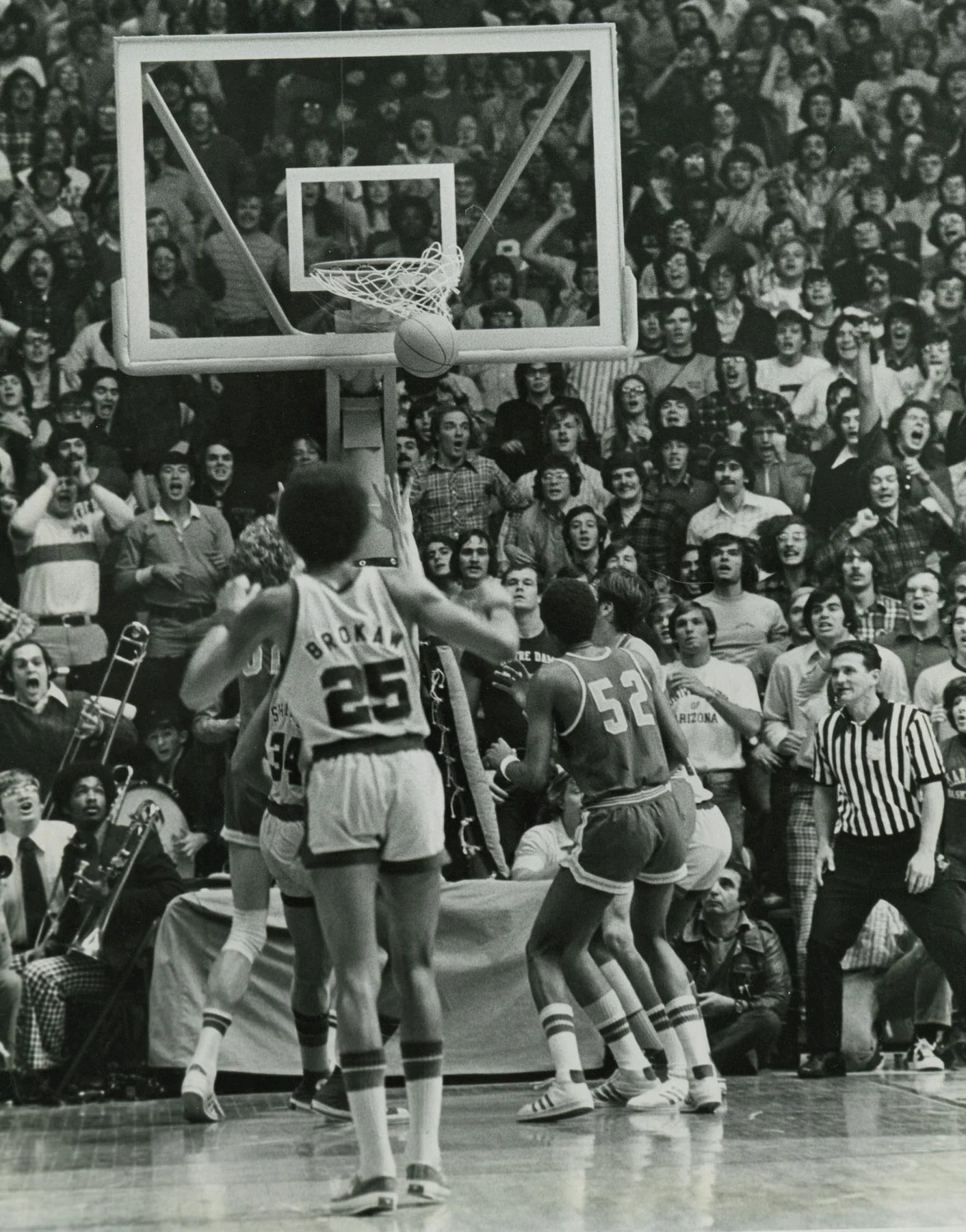
UCLA's men's Division I record streak reached 88 consecutive victories. The winning sequence ran from January 30, 1971 through January 17, 1974. Notre Dame ended it with a 71–70 victory on January 19, 1974. The date of the final victory and the date of the defeat are two separate endpoints, which explains why summaries can display different January dates without disagreeing.
An overall streak counts successive games, while a home streak isolates games at home. A regular-season streak can omit national postseason tournaments. A school can therefore have several streak figures at the same time, each reflecting a different set of games. If a graphic reports a home streak, it cannot be added to an overall streak to manufacture a larger record.
UCLA's sequence also demands continuity beyond one exceptional evening. Opponents can adjust, players can move through their college careers, and the schedule keeps supplying new situations. That repeated requirement is what gives a long team streak its distinctive weight. It says something different from having the most talented player in one statistical category.
UConn's 111-game women's streak
UConn's women's Division I overall winning streak reached 111, with victories from November 23, 2014 through March 27, 2017. Mississippi State ended the run on March 31, 2017 with a 66–64 overtime victory in the national semifinals. The NCAA's streak category includes national postseason tournaments, so the final defeat belongs to the same overall sequence.
The last winning date is important here too. March 27 identifies the victory that brought the total to 111. March 31 identifies the game that stopped it. A report issued before the semifinal describes an active run; the updated record book describes a completed run. Read the report's moment before deciding whether two dates represent an error.
The 111 and 88 marks belong to separate women's and men's competitions. They can be presented together as notable Division I team achievements while retaining those labels. The comparison does not need an assertion that the two schedules had identical opponents, rules or competitive conditions.
For a new team approaching a milestone, inspect every counted game and the category's exclusions. An overall loss ends an overall streak even if a home winning run continues. A national tournament result might matter differently to a regular-season category. Precise wording helps fans enjoy the pursuit without moving the conditions halfway through the comparison.
How to check an all-time record before sharing it
Begin at the NCAA's current statistics and records hub, then choose competition and division before choosing the statistic. An old PDF reached through search may still contain accurate historical information, but it can miss a later record change. Check the content's latest completed season rather than assuming that a familiar web address always points to the same edition.
Read the category heading and its notes together. Minimum attempts or appearances can affect an average record. Opponent conditions can affect a game record. A note about vacated results or eligibility can affect which ledger is appropriate. These details are part of the record's definition, not optional background to be discarded when copying a number.
For a recently finished career, cross-check the updated NCAA entry against the school’s final-season coverage. A report from a record-breaking game often contains a running total. Gilyard's steals record illustrates why the final ledger matters: first becoming the leader and finishing with 466 are different moments. The milestone report need not be wrong for its number to be too early for a completed-career table.
Do the same with streak dates. Preserve the final winning date and the subsequent defeat date as separate facts. If an older article describes an active streak, inspect what happened next before using its number as a finished record. A future game can extend or end a sequence without changing the accuracy of the earlier report at publication.
Use specialist comparisons when you need more than a benchmark. Our men's career scoring guide and women's career scoring guide provide broader scoring context. That lets this record overview keep rebounding, defensive events and team streaks visible rather than repeating the same scoring table in every category.
A complete claim usually fits into a simple sentence: name the holder, amount, statistic, competition and counting period. Add the opponent for a single-game achievement and the date boundary for a streak. If those elements cannot be established, describe the number as a reported milestone within its known limits rather than upgrading it into an unrestricted national record.
The reward for this care is a more useful basketball conversation. You can explain why a career rebounder, a rim protector and a team with a historic streak each achieved something demanding. The records become starting points for understanding the game, with the category intact and the underlying achievement easy for another fan to verify.
Sign in with Google to join the discussion.