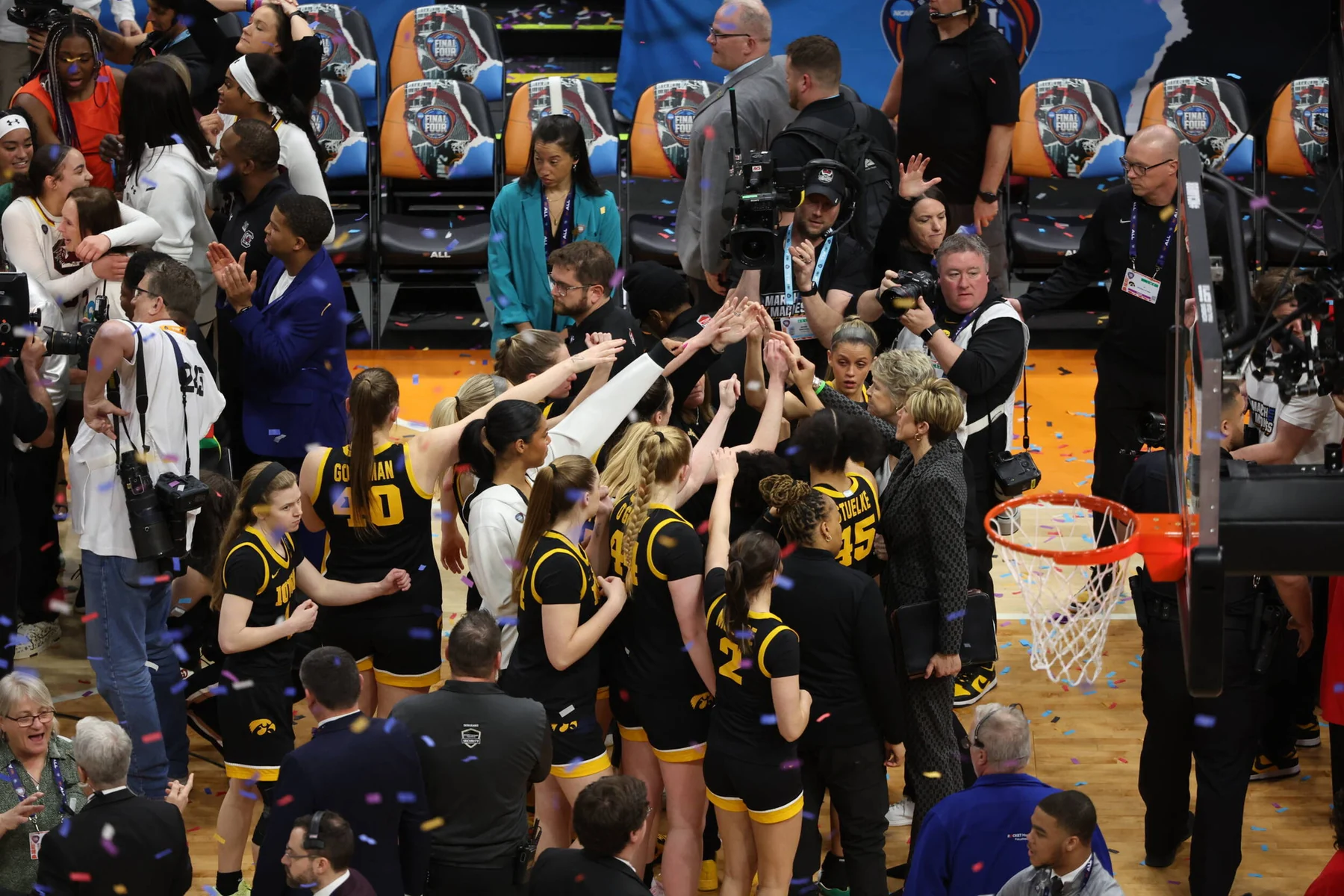
NCAA Division I women's career scoring top 15
Caitlin Clark is the NCAA Division I women's career scoring leader with 3,951 points. Kelsey Plum ranks second at 3,527, leaving a 424-point gap. The table is limited to women's Division I careers in the NCAA statistical era, which began with the association's first women's basketball season in 1981-82. It does not fold in AIAW careers from before NCAA sponsorship, NAIA totals, NCAA Divisions II or III, or points scored only in the NCAA Tournament.
| Rank | Player | School shown | Career end | Points |
|---|---|---|---|---|
| 1 | Caitlin Clark | Iowa | 2024 | 3,951 |
| 2 | Kelsey Plum | Washington | 2017 | 3,527 |
| 3 | Dyaisha Fair | Buffalo / Syracuse | 2024 | 3,403 |
| 4 | Kelsey Mitchell | Ohio State | 2018 | 3,402 |
| 5 | Jackie Stiles | Missouri State | 2001 | 3,393 |
| 6 | Brittney Griner | Baylor | 2013 | 3,283 |
| 7 | Patricia Hoskins | Mississippi Valley State | 1989 | 3,126 |
| 8 | Jerica Coley | FIU | 2014 | 3,107 |
| 9 | Rachel Banham | Minnesota | 2016 | 3,093 |
| 10 | Ashley Joens | Iowa State | 2023 | 3,060 |
| 11 | Elena Delle Donne | Delaware | 2013 | 3,039 |
| 12 | Maya Moore | UConn | 2011 | 3,036 |
| 13 | Katelyn Young | Murray State | 2025 | 3,029 |
| 14 | Chamique Holdsclaw | Tennessee | 1999 | 3,025 |
| 15 | Cheryl Miller | USC | 1986 | 3,018 |
The tightest placement is Fair over Mitchell by one point. That difference establishes order, not a meaningful claim that one had the better career. At the other extreme, Clark's 424-point cushion over Plum is larger than the gap from Plum to Stiles. The list should be read as accumulated scoring under each player's schedule and role, then supplemented with games, scoring average, efficiency, playmaking, defense, and postseason résumé.
Transfers are attributed transparently. Fair scored at Buffalo and Syracuse; a display that shows only her final school can hide part of the career path. For current team dates and opponents rather than historical totals, visit the women's college basketball schedule.
The 3,000-point threshold is itself selective. It requires roughly 750 points per season over a traditional four-year career, before accounting for injuries or shortened schedules. The names near the cutoff reached it through different game counts and roles, so the table should not be converted into an efficiency ranking. It is a milestone list with exact official ordering.
How Caitlin Clark created a 424-point lead
Clark did not reach 3,951 through one isolated skill. The official Division I record book breaks her 139-game total into 1,293 field goals, 548 three-pointers, and 817 free throws, producing a 28.4 career average. Her long range is the obvious visual signature, but the scoring record also reflects ball-screen volume, transition opportunities, rim pressure, free-throw conversion, and four seasons without a low-usage developmental year.
Range
548
Career three-point makes. Defenders had to engage far above the arc, opening driving and passing lanes.
Pressure
817
Made free throws. Foul-line production kept the total moving when pull-up shooting was less efficient.
Rate
28.4
Points per game across the full career, not just the record-breaking senior season.
Iowa's tempo and spacing turned those tools into repeatable possessions. Clark could pull up before a conventional drop defender expected to contest, force two defenders toward the ball, or deliver to a rolling post and weak-side cutter. Iowa says she led the nation in both scoring and assists per game in consecutive seasons. That matters because it shows defenses could not simply sell out against her shot without conceding creation elsewhere.
The final season supplied a remarkable closing surge: 1,234 points in 39 games, the NCAA Division I single-season record. Iowa also reached the national championship game for a second straight year. Clark's 492 points in 17 career NCAA Tournament games are already contained inside 3,951, but those deep bracket runs provided high-stakes opportunities that a scorer on an eliminated team would not receive.
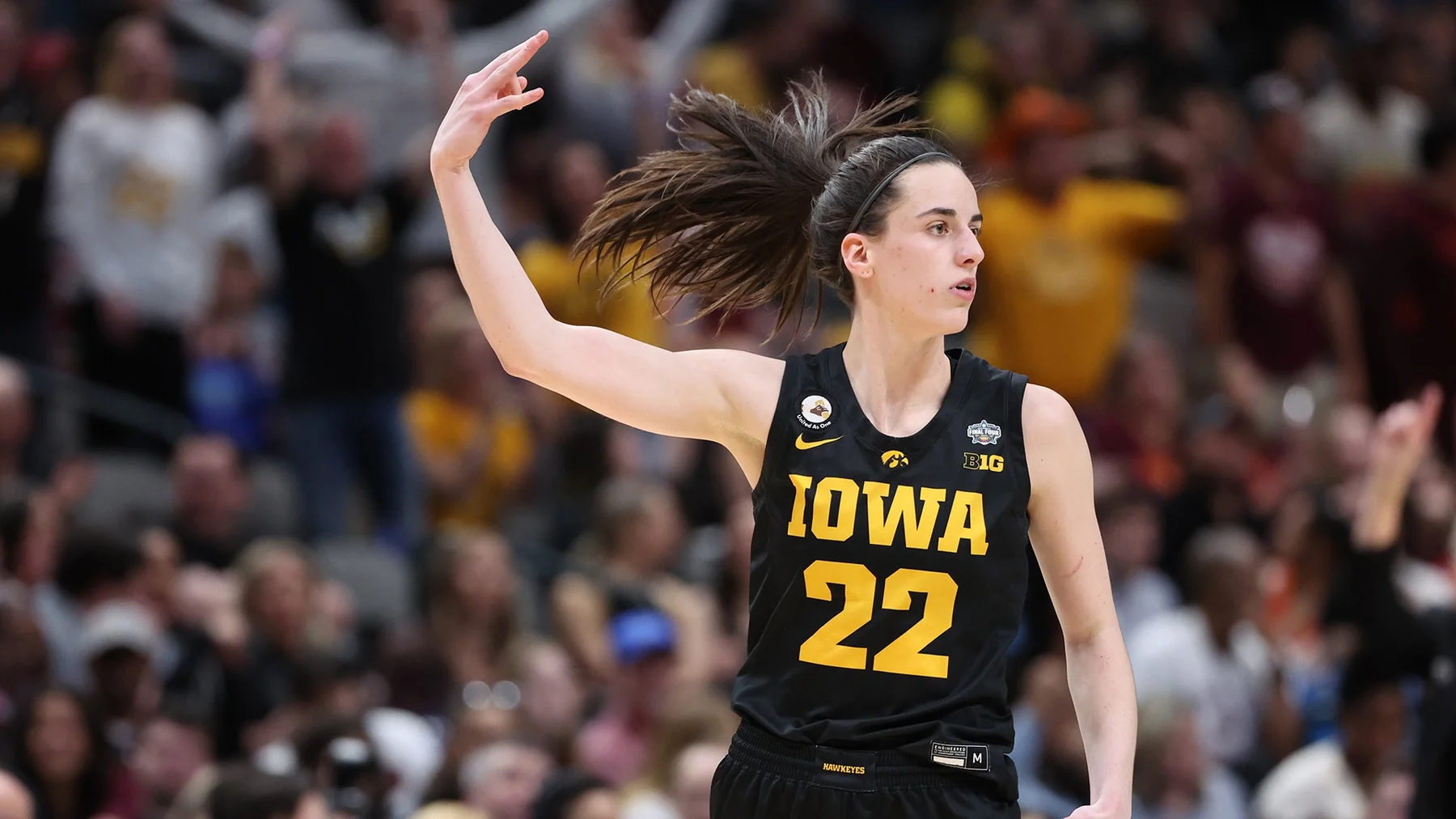
The 424-point lead over Plum is therefore both individual and structural. Clark maintained an extraordinary rate, stayed central to the offense, and played enough games to compound it. It does not mean every aspect of her career was 424 points “better.” It means no other NCAA Division I women's player has combined scoring rate and eligible opportunity into a larger official total.
Clark's passing also protects the scoring structure. When a second defender stepped up, she could make the roller or weak-side shooter the beneficiary instead of forcing a contested attempt. That kept Iowa from choosing between individual production and functional offense on every possession. The record reflects shots made, but the threat of the pass helped preserve the quality and volume of those shots.
The different scoring paths inside the top 10
The leaderboard is not ten versions of the same offensive role. Kelsey Plum and Jackie Stiles created heavy perimeter volume; Dyaisha Fair carried scoring across two programs; Brittney Griner converted interior position and free throws; Ashley Joens mixed wing strength, rebounding activity, and a long five-season career. Their totals belong in one points column, but the possession-level work was different.
Kelsey Plum and Jackie Stiles: records built through escalating responsibility
Stiles raised her scoring average in each season at Missouri State, culminating in 1,062 points as a senior and a 2001 Final Four run. Her 3,393 stood as the Division I record until 2017. Plum passed her with a 57-point performance against Utah, then completed the season at 3,527. Washington's records credit Plum with 912 career free throws, a reminder that even an elite jump-shooting guard builds totals by attacking contact and finishing bonus possessions.
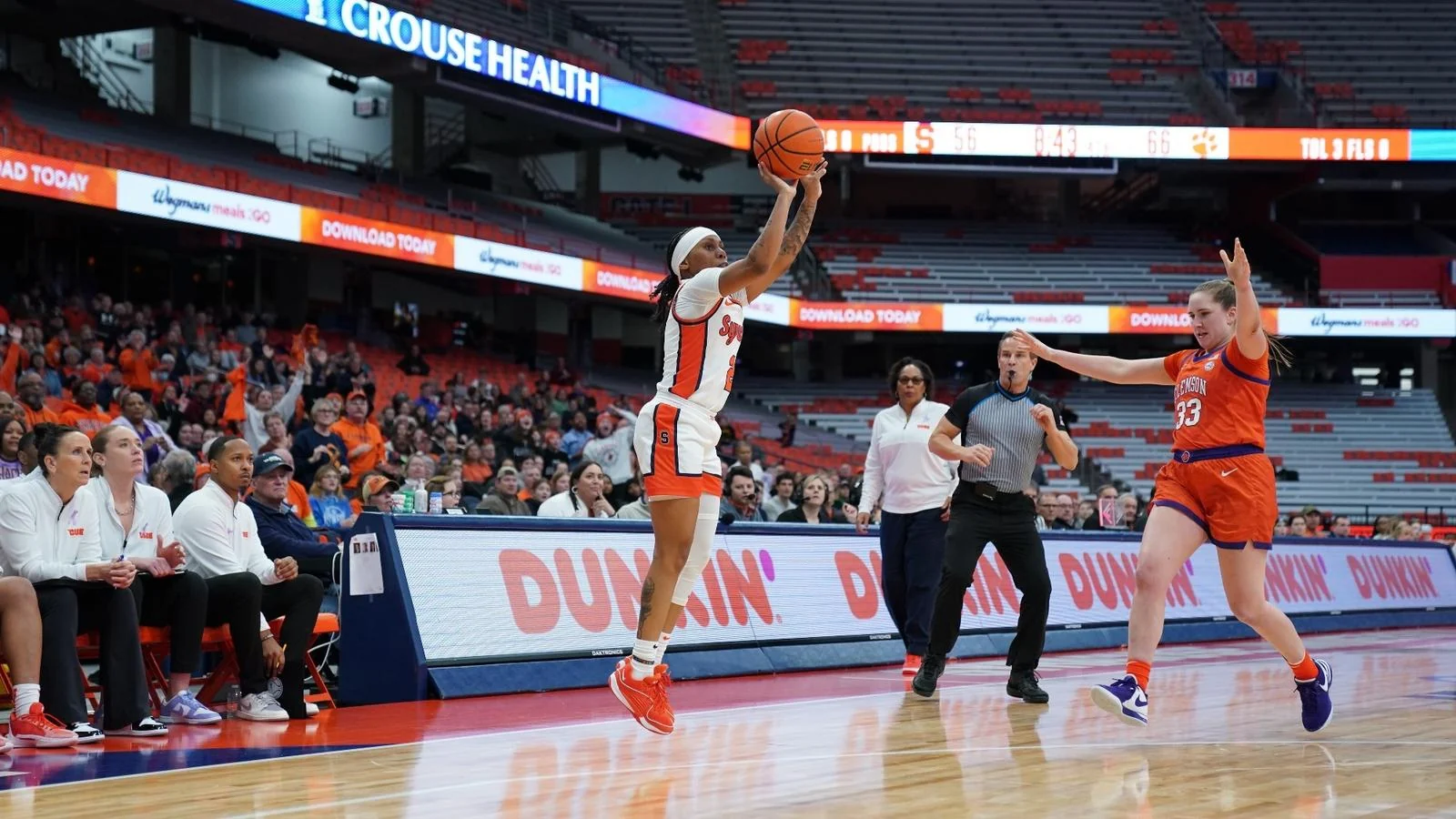
Dyaisha Fair and the transfer-era career
Fair's 3,403 spans Buffalo and Syracuse. The points travel with the player because this is a career record, not a single-program leaderboard. Her one-point edge over Kelsey Mitchell is official placement, but it is too small to carry a broad judgment. What matters tactically is how a smaller lead guard preserves scoring volume after changing conferences, teammates, spacing, and the quality of defenders assigned to her.
Brittney Griner: efficient interior volume with two-way dominance
Griner's 3,283 came at 56.9 percent shooting over 148 games, with 787 made free throws. Baylor could establish her near the rim, punish single coverage, and create foul pressure against undersized defenders. Her 748 blocks remain a separate NCAA record across men's and women's basketball. That two-way number is important because a scoring-only ranking otherwise understates how strongly she shaped games when Baylor went 40-0 and won the 2012 title.
The common thread is not position. It is sustained primacy without a collapse in availability or production. Defenses can top-lock a movement scorer, blitz a ball screen, switch length onto a guard, or front a post with weak-side help. A top-10 scorer repeatedly solves those plans across seasons. Fans comparing players should therefore ask how the points were created, how efficiently, and what other value came with the usage—not assume the higher career total settles every basketball question.
Shot location changes the burden on teammates. A post scorer needs clean entry angles and spacing that punishes digs; a pull-up guard needs screeners and outlets when two defenders meet the ball; a movement scorer needs timing and accurate delivery. Career points look individual in the book, yet the possession that creates them is coordinated. That is why role continuity and teammate fit belong in any serious comparison.
NCAA, AIAW, NAIA and tournament records are not interchangeable
Women's basketball history does not begin in 1982. NCAA sponsorship does. That distinction is essential: the NCAA Division I table starts with the 1981-82 season, while elite players before that competed under the Association for Intercollegiate Athletics for Women. Leaving Lynette Woodard out of an NCAA-era top 15 is a classification choice, not a claim that her points or competition did not matter.
NCAA Division I career record: Caitlin Clark, 3,951
This is the category used by the main table. It includes Clark's countable Iowa career games in the NCAA Division I era and is also the highest official D-I total across men's and women's basketball.
AIAW major-college landmark: Lynette Woodard, 3,649
Woodard scored 3,649 at Kansas from 1977-81, before NCAA sponsorship. The NCAA hosts a separate pre-NCAA/AIAW record book, and the Basketball Hall of Fame identifies Woodard as the AIAW scoring leader. Her category should be named rather than silently forced into a later NCAA table.
All-college/AIAW-era total: Pearl Moore, 4,061
Moore's widely cited 4,061 combines 3,884 at Francis Marion with 177 at Anderson Junior College. The NCAA-hosted AIAW book shows the Francis Marion component. Because the total spans a junior college and small-college AIAW competition, it is not an NCAA Division I career entry.
NCAA Tournament record: Caitlin Clark, 492
This counts March Madness games only. Clark produced 492 in 17 tournament appearances. Those points already sit inside her 3,951 career total; adding them again would double-count postseason games.
NAIA and NCAA Divisions II and III maintain still other record families. A scorer can own a valid all-level or association record without appearing in the D-I list. The safest wording is specific: “NCAA Division I women's career points,” “AIAW major-college points,” or “NCAA Tournament career points.” A bare phrase such as “women's college scoring record” invites several correct but incompatible answers.
The categories also describe different basketball opportunity. A tournament total depends on selection and advancement: a star cannot accumulate six March games if her team exits in the first round. A full-career total includes regular-season and conference-postseason work. An association record reflects the schedules and statistical rules under that governing structure. Precision preserves all of those accomplishments instead of ranking history through a misleading single column.
AIAW recognition is especially important because women's programs, coaches, and athletes built national competition before the NCAA administered it. Naming the earlier governing body prevents two opposite errors: pretending those careers were NCAA careers, or pretending they do not belong in college basketball history. A precise label is an act of inclusion because it preserves the achievement on its actual terms.
How to read the list and follow the next chase
Start with the record's narrow answer—Clark, 3,951—then add games and scoring rate before comparing careers. A one-point rank difference between Fair and Mitchell is not analytically large. A 400-point gap is large, but still does not incorporate defense, passing, efficiency, team success, or era. Career points measure accumulated scoring, and they should be treated as exactly that.
A simple chase calculation
For an active player, subtract her current total from 3,952, the number required to move ahead of Clark, then divide by the maximum plausible games remaining. Use a range because conference and NCAA Tournament advancement is unknown. If a player needs 900 points and could play 30 to 40 games, the required average ranges from 30.0 to 22.5. The lower number depends on reaching the longer schedule; it should not be presented as guaranteed opportunity.
After the 2025-26 season, Notre Dame's Hannah Hidalgo had 2,460 points through 103 games, a 23.9 career average. She was 1,491 points from tying Clark and would need 1,492 to pass. That arithmetic shows why “on pace” headlines require caution: even another elite season would not automatically close the gap, and no responsible preview can guarantee eligibility decisions, health, role, or postseason games.
Five checks before updating a chase
- Use the official final box score, including conference and NCAA postseason games.
- Confirm whether the displayed total combines transfer schools.
- Separate a season points page from a career points table.
- Calculate both points to tie and points to pass.
- Date the update and never count a scheduled game before it is played.
Basketball context matters within the arithmetic. A scorer facing aggressive traps may create more assists while her points dip; that can improve the offense without helping the chase. A team's bracket run adds possessions, but advancing also brings stronger defenses, shorter preparation windows, and neutral-court pressure. Free-throw rate and late-game usage can stabilize production when three-point variance turns against a player.
Use the NCAA statistics hub for finalized season numbers, the player's school page for career and roster context, and a current leaderboard for ordering. Then use the college basketball schedule today to locate the next confirmed game. This article was checked August 22, 2026; any future chase should carry its own timestamp rather than silently treating these totals as live.
A useful tracker should also show the player's recent scoring average beside the career average. The recent number reflects current role and opponent response; the career number prevents a short hot streak from becoming the whole forecast. Neither accounts for unplayed postseason rounds. Presenting both, with a games-remaining range, makes the assumptions visible enough for readers to challenge them.
Sign in with Google to join the discussion.