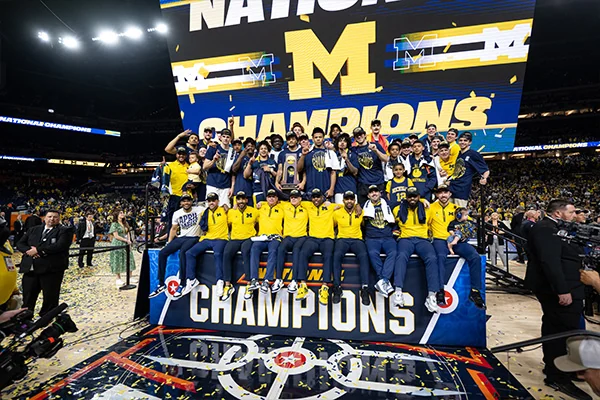
Which teams have clinched a 2027 March Madness automatic bid?
As of September 29, 2026, no team has clinched a 2027 NCAA Division I men's or women's basketball automatic bid. The 2026–27 conference championship games that determine those berths have not taken place. This page therefore starts with an empty, dated ledger rather than filling the spaces with preseason favorites or last season's champions. A team that lifted a conference trophy in March 2026 has a 2026 result, not a reservation in the 2027 bracket.
Both 2027 tournaments will have 76 teams. Each field contains 32 automatic qualifiers and 44 at-large selections, according to the NCAA's separate men's and women's championship selection guides. Those numbers describe two distinct tournaments, not a combined pool of 64 automatic berths. A program can appear in both the men's and women's races, but its two teams earn places independently.
Men's automatic qualifiers: current status
The men's confirmed-AQ count is 0 of 32. No men's conference champion should be added until its league has completed the qualifying tournament and the winner is identified under that league's official rules. This matters because a strong regular-season record or a projected No. 1 conference-tournament seed does not by itself settle the title game. A favored team may lose; a lower seed may survive a three- or four-game run and take the guaranteed place instead.
For a men's team, our future ledger will record the conference, the winning school, the championship game result, the date, and the league's official result link. It will avoid a bare list of school names that leaves readers guessing whether a bid was won on the court or merely projected by an analyst. Fans following the eventual bracket can pair this ledger with our 2027 March Madness dates and format guide.
Women's automatic qualifiers: current status
The women's confirmed-AQ count is also 0 of 32. The women's tournament has its own selection committee and its own 44 at-large choices. A women's team ranked among the national favorites may be very likely to make the field in some fashion, but “likely to make the field” is not the same claim as “has clinched the conference automatic bid.” We will reserve the latter wording for a confirmed league champion.
That distinction is useful during conference week. Suppose a highly ranked women's team reaches its league final. It has a chance to claim the AQ, while its broader résumé may also support an at-large selection if it loses. Neither possibility should be marked as an automatic clinch before the final is complete. The same discipline applies to the men's field. Until then, the honest tracker is a status update, not a list of expected winners.
How does a team actually earn an automatic bid?
An automatic qualifier, often shortened to AQ, is the conference representative whose NCAA Tournament place is guaranteed by the league's qualifying result. For the 2027 Division I men's and women's basketball championships, the NCAA's selection guide identifies the conference tournament winner as that representative. Thirty-two such winners enter each 76-team field. The selection committees choose the other 44 teams at large, then seed and place the full field.
That definition gives conference tournaments unusual stakes. A team can spend four months building a respected résumé and still lose the league's guaranteed bid on the final night. Another team may have a modest regular-season record, get hot over several tournament games, and earn the same certainty. The winning path is determined by the conference bracket, including any byes and eligibility rules announced for that season. The national committee does not replace a valid champion just because a different school rates better in a predictive model.
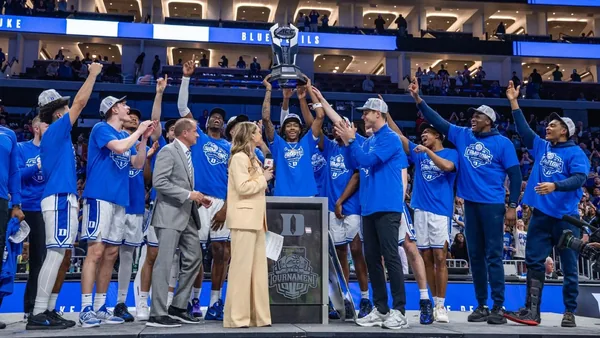
Conference tournament winner versus regular-season champion
The regular-season title and the tournament title answer different questions. The first rewards the league schedule, which tests a team across home courts, road trips and many opponents. The second rewards survival through a compressed knockout event. A regular-season champion may be the top seed in its league tournament, but that seed is an opportunity, not the AQ itself. When the final buzzer sounds in the qualifying championship game, the tournament winner claims the league's NCAA berth under the current NCAA basketball framework.
The distinction also prevents confusion with other postseason competitions. The NCAA's selection overview describes separate paths for the men's NIT and women's WBIT. For example, a women's regular-season conference champion that misses the NCAA field may have WBIT automatic-qualification rights under that event's rules. That does not retroactively turn the school into a Women's March Madness AQ. When a headline says “automatic bid,” the competition named after it matters.
When a conference has an unusual qualification rule
Fans should verify the league's own championship rules before assuming that every team in its standings is eligible for the AQ. Tournament participation, ties, institutional eligibility and a school's transition status can affect who is allowed to represent a conference. The NCAA's broader Division I automatic-qualification bylaw requires an eligible conference champion to be determined by the selection date and sets out procedures for particular exceptional cases. It is a framework for administrators, not evidence that an exception has happened in 2027.
Our tracker will therefore follow the officially designated qualifier, backed by a conference championship release or result and, if an unusual case arises, the conference's explanation. A projected bracket can show who looks strongest; the final score and designation show who owns the automatic place. That standard is especially important after a close title game, an overtime finish or a surprise result that changes the national bubble picture within minutes.
How the 76-team fields change the stakes for automatic qualifiers
Expansion gives more teams a place in March Madness, but it changes what the first assignment may look like for a conference champion. The men's and women's fields each grow from 68 to 76 teams in 2027. The 64-team First Round survives. To reach it, 24 teams in each tournament first enter a 12-game Opening Round. The NCAA specifies that the 12 lowest-seeded automatic qualifiers play six games against one another; the 12 lowest-seeded at-large teams occupy the other six games.
The seeding phrase matters. An AQ is guaranteed a spot in the tournament, not a guaranteed passage straight to the round of 64. The committee will rank every selected team on an overall seed list, then identify the lowest-seeded champions for the Opening Round. A league's media profile alone does not decide the assignment. Until Selection Sunday, readers should avoid attaching a particular school or conference to one of those twelve positions.
The Opening Round path for lower-seeded champions
For a champion drawn into that group, the title game creates a second immediate problem: prepare for another elimination game with little time to recover. Its staff must scout an unfamiliar opponent, manage travel, and decide how much to adjust its usual rotation after the physical load of a conference tournament. The basketball work is concrete. A team that lives on offensive rebounds might face a frontcourt with a very different box-out scheme; a transition team may need a half-court answer if a new opponent slows the game. Those are examples of scouting questions, not claims about 2027 matchups that have yet to exist.

On the men's side, the NCAA has set the 2027 Opening Round for March 16–17, with Dayton, Ohio, and Wichita, Kansas, hosting tripleheaders on both days. The women's Opening Round starts March 17 and uses selected campus sites that also host First- and Second-Round play. This difference affects travel and atmosphere. A men's champion may move from its league tournament to one of two neutral-site cities and then onward if it wins. A women's champion may start at a campus site where the following rounds are also staged. Actual destinations, opponents and tip times remain bracket-dependent.
There is also a useful antidote to a common misconception: an Opening Round participant is already an NCAA Tournament team. A win advances it to the 64-team First Round; a loss ends its run, but it still earned and used the conference's automatic berth. For a program making its first appearance in years, that distinction matters to its record books and to fans watching Selection Sunday. The expanded entry stage changes the path through March, not the validity of the league championship that got the team there.
How to follow conference championship week without mistaking a projection for a clinch
Championship week can make every bracket graphic look official. It is not. A “projected lock” reflects an analyst's assessment of the at-large case; a “conference favorite” reflects an expected game result; an automatic qualifier is the program that has actually secured its league's designated NCAA berth. Those claims may all concern the same team at different moments, but they need different evidence. A top seed that has not played the conference final has not won the AQ, even if nearly every projection includes it in the national field.
The source and timestamp checklist
For each men's or women's conference final, start with the league's official bracket, schedule or championship page. Verify that the game is the qualifying final, then read the final score and the league's release identifying its NCAA representative. Record the result date and time zone. If a feed calls a game “final” but the league has not yet posted its designation, the accurate status is “title-game winner, AQ confirmation pending.” If a postseason eligibility wrinkle arises, wait for the conference and NCAA to explain it.
Next, distinguish the conference result from the national bracket. The NCAA selection committees choose 44 at-large teams in each tournament, and their final seeding work continues as late championship games are resolved. A league title tells you a team belongs in the 76-team field. It does not tell you its national seed, Opening Round assignment or opponent. Those details become official only when the relevant men's or women's bracket is revealed.
A dated ledger should show five useful fields: conference, qualifying champion, championship result, confirmation source, and checked-at time. The tracker can then be audited after a correction, overtime result or late Sunday game. Readers planning an evening around a title game should use the current college basketball schedule for tip times and return here for verified qualification. Those are related fan jobs, but the game schedule can change before the AQ count does.
The bubble impact of an unexpected champion
The NCAA calls a team on the edge of at-large selection a bubble team. Imagine a league where its regular-season leader has an at-large résumé, while a lower seed would need the conference championship to get into March Madness. If the lower seed wins the final, it takes the AQ. The leader may still be selected at large. In that case the league sends two teams where many forecasts had effectively reserved one spot, and a different bubble team can be pushed out. That is the familiar “bid stealer” mechanism.
It is a conditional scenario, not a claim that any 2027 program has already stolen a bid. It also depends on the losing team's actual at-large selection, which only the committee can confirm. A surprise winner from a league whose runner-up also misses the field does not squeeze another bubble team in the same way. Look at the whole bracket, not just the upset score, before describing the consequence.
What happens after Selection Sunday?
The conference-title ledger tells fans who earned a guaranteed place. Selection Sunday supplies the missing national context. The separate men's and women's committees complete the at-large portions, rank each field and place 76 teams in the official brackets. At that point, a confirmed AQ has a seed line, an opponent or a pending Opening Round matchup, and a route through its region. Before the reveal, any graphic assigning those details is a projection.
Read the bracket in two passes. First, identify how a school entered: conference champion or at-large selection. Second, check whether it must play in the Opening Round. The 12 lowest-seeded automatic qualifiers are paired into six games, and the 12 lowest-seeded at-large teams are paired into six more. A team from either path that wins joins the 64-team First Round. The route is different, but both sorts of Opening Round teams already belong to the official 76-team field.
The calendar gives this transition urgency. The men's Opening Round is scheduled for March 16–17, 2027, while the women's is scheduled for March 17–18. Both proceed to their 64-team First Round later that week. For coaches, the challenge is rapid scouting and recovery after the conference tournament; for fans, the practical questions are the verified site, local tip time and actual broadcast outlet. Those specifics should be checked against the final NCAA bracket and game schedule, not guessed from a league title result.
A useful tracker will change over three phases. Before championship week, it correctly shows zero confirmed bids. As finals end, it adds league winners with source links and timestamps. After the brackets appear, it can append seeds and first games while preserving the original AQ evidence. That history lets a reader see exactly when a team moved from contender to conference champion to bracket participant. Our 2027 tournament schedule guide has the wider date-and-site picture; this page remains the place to verify how each automatic berth was earned.
Sign in with Google to join the discussion.