Our early-season SEC forecast and what it measures
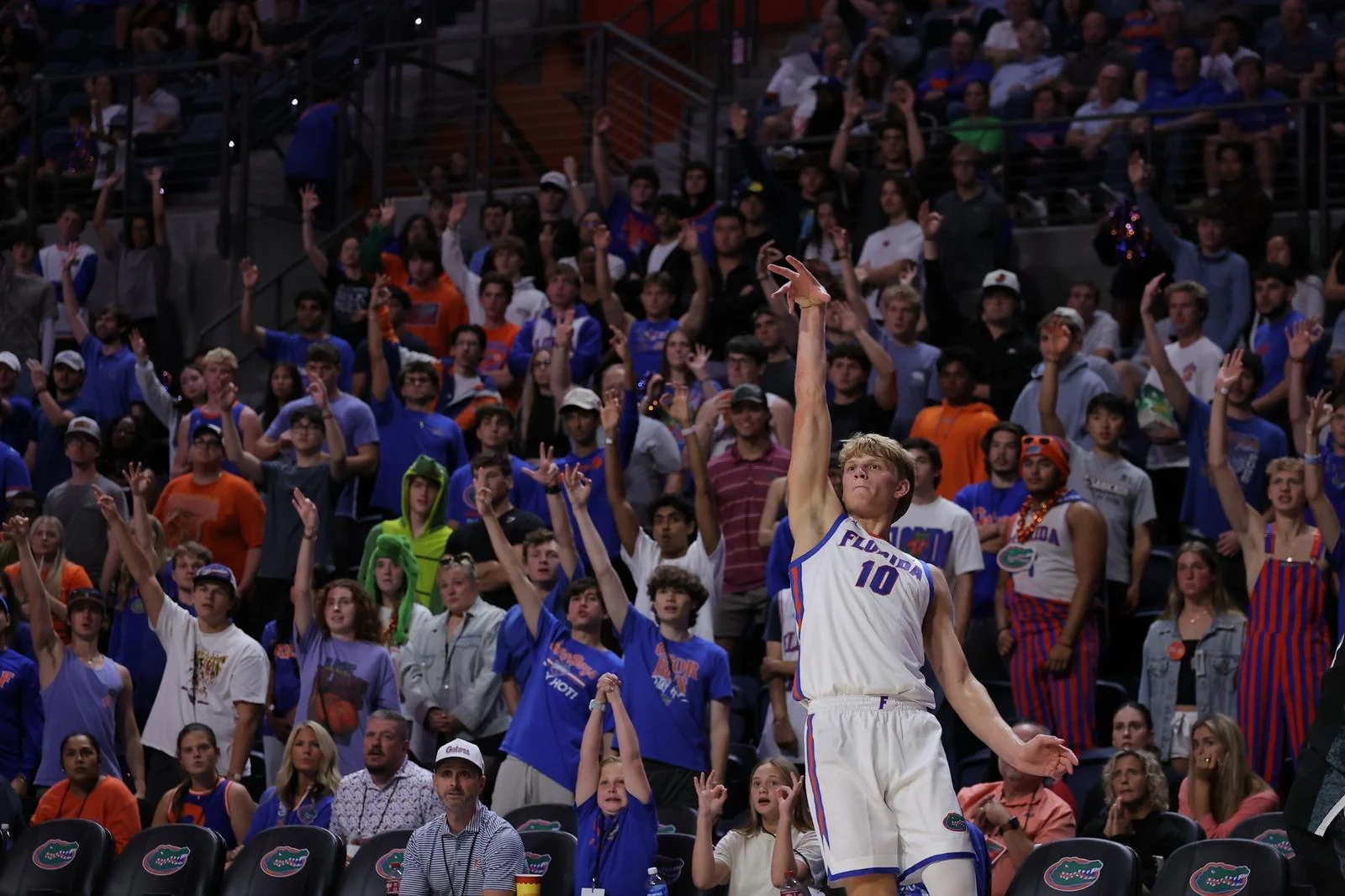
Florida is our choice to win the 2026-27 men's SEC regular-season race, with Texas the leading challenger. Tennessee and Arkansas complete our first contender group. This is College Basketball Schedule's editorial forecast, checked November 12, 2026, using completed games through November 11. It is neither an official conference table nor an ESPN, CBS or AP ranking republished under a different name.
| Our order | Team | Forecast group |
|---|---|---|
| 1 | Florida | Favorite |
| 2 | Texas | Leading challengers |
| 3 | Tennessee | Leading challengers |
| 4 | Arkansas | Leading challengers |
| 5 | Alabama | Can reshape the race |
| 6 | Vanderbilt | Can reshape the race |
| 7 | Kentucky | Can reshape the race |
| 8 | Missouri | Can reshape the race |
| 9 | Texas A&M | Chasing pack |
| 10 | Auburn | Chasing pack |
| 11 | Georgia | Chasing pack |
| 12 | Oklahoma | Chasing pack |
| 13 | Ole Miss | Chasing pack |
| 14 | LSU | Chasing pack |
| 15 | Mississippi State | Chasing pack |
| 16 | South Carolina | Chasing pack |
The order weighs returning production and current roles, then asks how reliably a team can create a decent shot, finish a defensive possession and function when its preferred action is taken away. Opening results matter, but a handful of games cannot settle an 18-game conference race. Neighboring positions are less certain than the broader groups; the table should be read as a set of arguments to test.
The official preseason media poll also favored Florida, followed by Texas, Arkansas and Tennessee. We place Tennessee above Arkansas at this early checkpoint, with the reasons and caveats below. The media poll is evidence about expectations, not a set of results that teams have already earned. SEC league play does not begin until January 2, so November's overall wins and losses are not conference wins and losses.
Predictive models add another view, but their outputs depend on their inputs and update date. Our BPI explanation helps distinguish a model rating from a poll or a record. We are not attaching invented win probabilities or exact league records to these teams. The useful question is which basketball traits can survive repeated SEC tests, and what new evidence would justify changing the order.
Why Florida remains the team to beat
Our Florida pick starts with an unusually persuasive set of returning frontcourt roles. Thomas Haugh, Alex Condon and Rueben Chinyelu are seniors with established responsibilities, rather than three names assembled from recruiting rankings. The school confirmed all three on the coaches' preseason All-SEC teams, with Haugh also recognized as preseason player of the year. Those honors do not win games, but they point to a core whose college work is already visible.
A proven frontcourt gives the Gators several ways to win
Chinyelu averaged 10.9 points and 11.2 rebounds in 2025-26, according to Florida's current profile of its center. The rebounding is central to our argument. A good defensive sequence only becomes useful if the opponent does not retrieve the miss. A reliable interior presence gives the perimeter defense a chance to turn a stop into the next offensive possession.
With Haugh and Condon alongside him, our expectation is that Florida can solve more than one kind of half-court problem. That is an editorial projection about the combined frontcourt, not a claim that every matchup will be favorable. The tests are whether spacing remains functional against a packed defense, whether the ball reaches the right player on time and whether the guards can keep the offense organized under pressure.
The first road test adds evidence, not certainty
Florida's November 10 win at Florida State offers a more concrete checkpoint than a preseason accolade. The Gators won 81-72, with Haugh producing 21 points and 10 rebounds and making 10 of 12 free throws in the official box score. That is evidence of a player delivering scoring, possession-finishing work and foul-line points in a road setting.
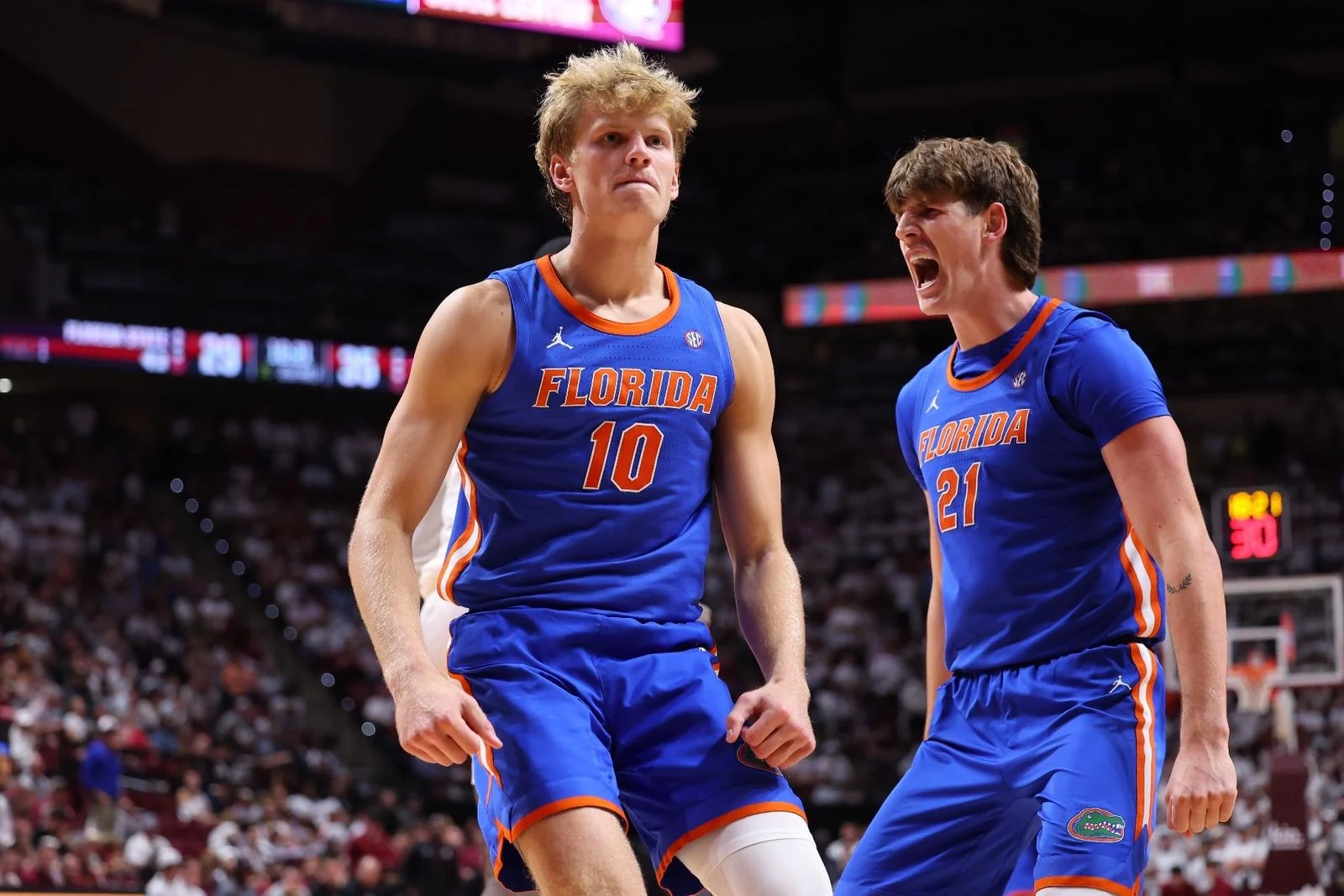
It does not establish that Florida is immune to a bad shooting night, foul trouble or an opponent that disrupts its entry passes. A three-game start is too small to resolve those questions. We keep the Gators first because the roster case and the road-game evidence currently point in the same direction. We would become less confident if repeated games showed that their interior advantages disappear when the first action is denied or that defensive possessions are ending in preventable second chances.
Texas, Tennessee and Arkansas form the next tier
Texas is our nearest challenger to Florida because the interior case is already accompanied by productive opening games. Tennessee and Arkansas have different routes to the same tier: Tennessee must organize talented pieces into repeatable possessions, while Arkansas must show that an early difficult afternoon was a correctable performance rather than a recurring limitation. The gap between third and fourth is provisional.
Texas has an interior foundation to build around
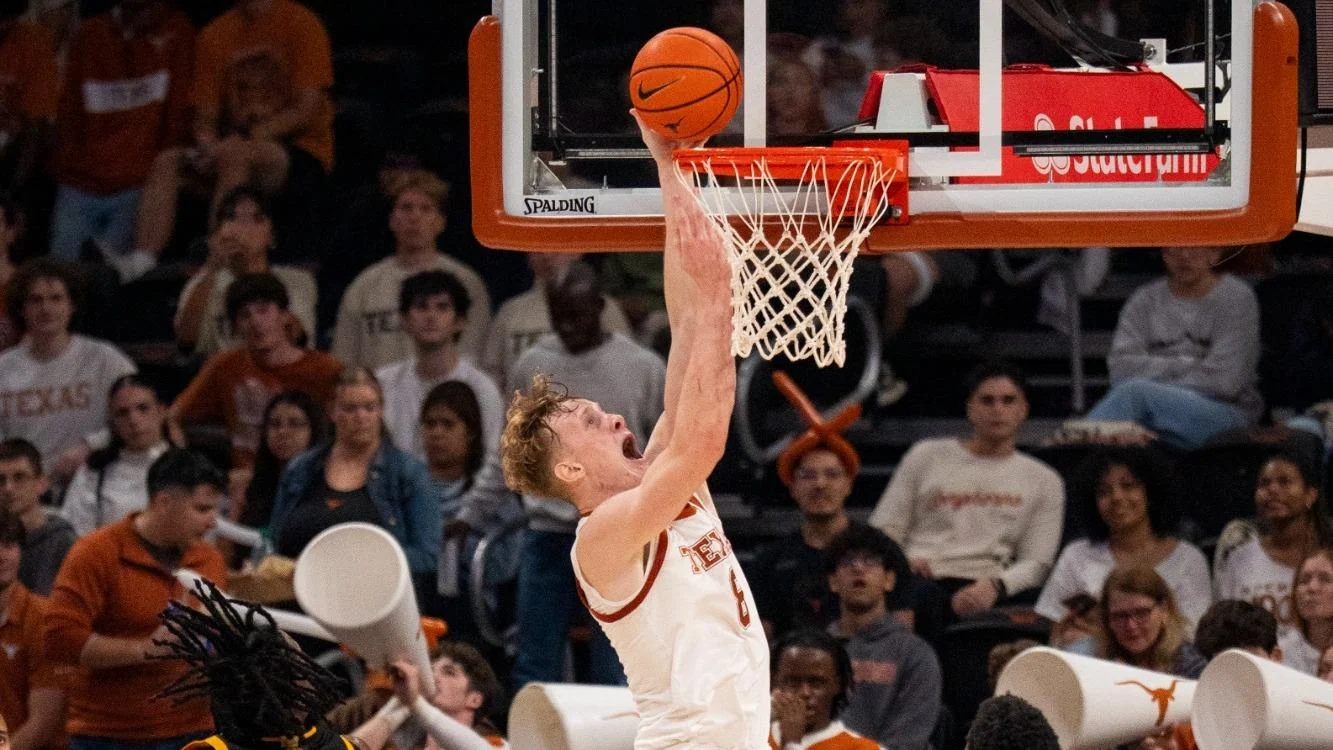
Matas Vokietaitis scored 26 points and collected nine rebounds in Texas's November 9 win over Grambling State, 93-62. Five Longhorns reached double figures. That combination is more interesting than the margin alone: a productive center can anchor the attack while other players contribute, rather than requiring every possession to end with the same scorer.
Texas's official preseason roster discussion also identifies David Punch as a transfer from TCU. His addition is a reason to examine how the frontcourt roles fit together, not to treat his previous production as points Texas has already scored. Our favorable projection requires the guards to deliver useful entries, the bigs to make quick decisions against help and the defense to finish possessions. A home win over Grambling establishes progress against that opponent; it does not establish superiority over Florida.
Tennessee needs its pieces to become a coherent offense
Tennessee's 70-47 win over Radford on November 9 supplied a useful defensive result and an efficient individual performance: Terrence Hill Jr. scored 18 points on 6-of-9 shooting. We place the Volunteers third because their path to a contender's level does not require every possession to become an individual rescue attempt. The objective is to turn available scoring into an offense that can repeatedly reach an advantage.
Our next test is how that work looks when an opponent can contest the first pass and finish its own possessions. Look for who initiates, who makes the next decision and whether a missed shot leaves Tennessee positioned to defend. Holding one early opponent to 47 points supports a positive opening assessment; it cannot by itself establish where a defense belongs nationally.
Arkansas has upside and an early warning
Arkansas's 91-72 neutral-site loss to Virginia on November 8 is the clearest warning among our top four. The official game statistics show Jordan Smith Jr. scoring 19 points, so the result was not a simple absence of individual offense. The larger question is whether the Razorbacks can keep creating usable possessions while preventing an opponent from building a sustained run.
We keep Arkansas in the contender tier because one difficult game should adjust confidence rather than erase the roster case. We move Tennessee narrowly above it because Arkansas has already shown a problem against a strong test that needs an answer. A subsequent win matters most if it demonstrates cleaner decisions and stronger defensive possessions, not simply a more favorable shooting percentage against a different opponent. Follow those tests on the SEC men's schedule; the ranking is meant to be challenged by the games.
Four teams could change the shape of the race
Alabama, Vanderbilt, Kentucky and Missouri are close enough to the leading group to make a rigid favorite-versus-everyone-else split unhelpful. Each has a plausible route upward, but each also presents a question that a good scoring total alone cannot answer.
Alabama: test the defense as well as the scoring
Alabama beat Oakland 109-68 on November 9 and made 24 of 46 three-point attempts. Amari Allen supplied six assists. That is a vivid demonstration of what can happen when shot creation and shotmaking connect, and it is part of why we place the Crimson Tide fifth rather than outside the race.
The same official game center also lists Oakland ahead 37-31 in rebounds. We would not treat that number in isolation as a complete defensive evaluation, particularly after such different shooting performances. It does, however, keep the possession question visible. Our forecast improves if Alabama can produce good offense while reliably finishing stops when the three-point percentage is less spectacular. Projecting another 52.2 percent night from deep would be a weak foundation for a season prediction.
Vanderbilt: Tanner sets the standard
Tyler Tanner's preseason recognition gives Vanderbilt a credible guard to build around. The November 10 win over Memphis, 105-81, added evidence about the help around him: Tanner scored 17, while Ace Glass scored all 23 of his points after halftime. Vanderbilt also won the rebound count 44-29.
We read that as a favorable example of an offense getting a major contribution beyond its most established name. It does not make every scoring burst repeatable. To move above sixth, the Commodores need that support to remain useful when a defense makes Tanner work for an initial advantage. Watch whether the next player can attack a rotating defense without turning a useful opening into a rushed shot.
Kentucky: convert roster talent into reliable possessions
Kentucky's November 10 loss to Kansas, 89-69, is already part of this forecast. The Wildcats made 4 of 21 threes and committed 15 turnovers; Kansas scored 22 points off those miscues, according to Kentucky's official postgame notes. Zoom Diallo's 24 points and Malachi Moreno's 19 points and 10 rebounds still demonstrate productive individual work.
The gap between those individual contributions and the team result is the question behind seventh place. Kentucky must turn its scoring options into possessions that survive pressure and leave a defense behind the ball. Better shooting would help, but it would not make the turnover cost disappear. We would be more convinced by several games showing improved decisions than by one explosive home score.
Missouri: separate an early loss from a season verdict
Missouri lost 90-84 to Saint Louis on November 6 despite 26 points and nine rebounds from Bryson Tiller and 21 points from Mark Mitchell. Saint Louis made 14 of 25 threes. That combination supports caution about drawing a sweeping conclusion from the result: there was useful Missouri production as well as an opponent shooting night that demands context.
It would be equally careless to assume every defensive concern vanishes when opponent shooting normalizes. The next review should ask how many shots were clean, how the Tigers defended the initial action and whether they secured the rebound after a miss. Eighth place is a tentative assessment of the season case, not a dismissal of a roster after one game or a prediction that it cannot challenge the teams above it.
The chasing pack has a route upward
The lower half of this order is where false precision would be most misleading. A placement of 12th rather than 13th is not a forecast of a fixed win total, and a team in this group can still beat a contender on a given night. The relevant distinction is whether it can produce enough reliable possessions across the league schedule to move beyond isolated upsets.
Guard play can move Texas A&M, Auburn and Mississippi State
Texas A&M's PJ Haggerty and Auburn's Tahaad Pettiford appeared on the media's preseason All-SEC third team. Mississippi State's Josh Hubbard was a first-team choice. That recognition provides a reason to look beyond the projected team order: capable perimeter players are distributed throughout the conference, rather than concentrated entirely in our top tier.
Pettiford scored 26 in Auburn's 75-53 win over Appalachian State on November 9. Hubbard reached 2,000 career points as Mississippi State beat Jackson State 98-57 the same night. Those are concrete reminders that a guard can perform at a high level even when our forecast remains cautious about the team's overall conference path.
The step upward requires support. When a defense traps or denies the primary creator, someone must turn the next pass into a good decision. When that creator misses, the group must still defend and rebound. We rank A&M and Auburn ninth and tenth and Mississippi State 15th provisionally; those positions should change if the surrounding work proves stronger than the starting expectation. An individual milestone deserves recognition without being converted into an automatic team title claim.
Look for repeatable progress in the rest of the field
Oklahoma has a specific continuity argument in returning starters Xzayvier Brown and Derrion Reid. The school's preseason release lists Brown at 15.4 points and 3.3 assists and Reid at 11.7 points and 4.4 rebounds in 2025-26. Those are prior-season figures. They identify experienced roles to evaluate, not a promise that the same production automatically carries into every new matchup.
For Georgia, Ole Miss, LSU and South Carolina, our lower placements express uncertainty about sustained conference-level performance rather than a claim that the teams lack useful players. The opening results already show why raw margins are a poor shortcut: LSU beat Texas Southern 92-51, while South Carolina beat Southeast Missouri State 78-68. Different opponents and game circumstances prevent a fair ranking from being read directly out of that comparison.
Ask whether progress repeats when the opponent changes. Do the guards keep possession under pressure? Can the frontcourt end a stop with a rebound? Does the offense reach a usable second option? Several convincing answers against increasingly difficult opposition would be a stronger reason to revise this group than a single unusually hot night. The conference schedule identifies where those next tests are coming.
What would make us change these predictions
The quickest way to improve this forecast is to test the reasons behind it. Florida's first place depends on its interior strengths remaining useful against different defenses. Texas's second place requires the surrounding pieces to turn a strong center into a complete team. Tennessee's third place asks for coherent offense alongside defensive work. Arkansas's fourth place assumes that its early problems can be corrected rather than repeatedly reproduced.
For each team, watch possessions before consulting the final margin. Turnovers that immediately become opponent points are different from a late-clock heave. A contested miss with a clean defensive rebound is different from a stop followed by two extra opponent attempts. A good three-point look that misses can be more encouraging than a difficult make that keeps rescuing a broken possession. The purpose is to identify what can repeat when shooting luck changes.
Use more demanding opponents as fresh evidence without pretending one opponent is a perfect measuring device. Tennessee's November 17 meeting with Michigan State is an upcoming checkpoint at this article's cutoff, for example. It can answer some questions about pressure and execution while leaving others unresolved. Repeated performances, particularly away from home, deserve more weight than a single convenient highlight.
Before league play, recheck actual player roles and officially reported availability. A changed rotation can alter the forecast, but an assumed injury return or a rumor should not be smuggled into a ranking as fact. During the conference season, compare the schedule paths as well as records: an 18-game slate with three repeated opponents gives every school a broad league test without making every itinerary identical.
Finally, keep the products separate. Our regular-season prediction is not a claim about who will win every elimination game in the SEC Tournament. An AP vote, a model rating and an actual league record answer different questions, as the college basketball rankings guide explains. Florida is the current pick, not an appointed champion. The useful forecast is the one that tells you what would prove it wrong and lets the next games supply that evidence.
Sign in with Google to join the discussion.