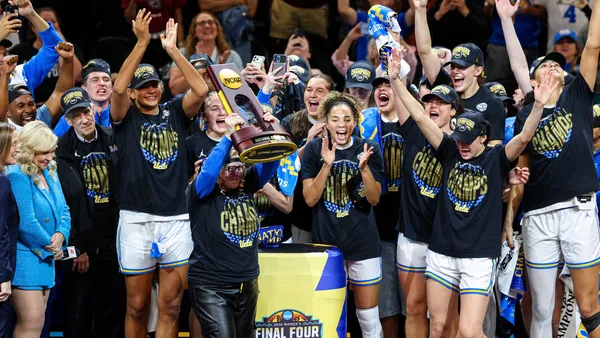
Use this guide for two different lookups: scan the chronological tables to find the NCAA Division I women's champion for a particular season, or use the school ledger to compare total championships. Both views cover the first NCAA tournament in 1982 through UCLA's completed 2026 title run.
The count is deliberately narrow. It includes one trophy for each completed NCAA Division I tournament, preserves 2020 as a canceled event with no winner, and keeps AIAW championships in a separate historical category. That method produces 44 NCAA champions across 17 programs. UConn leads the school ranking with 12, Tennessee follows with eight, and UCLA is the latest first-time winner.
Scores in the year tables are championship-game results. They are not semifinal scores, poll rankings or conference-tournament finals. School totals exclude runner-up finishes and Final Four appearances. The result is a reference that can be audited row by row without changing the definition midway through the comparison.
Who has the most NCAA women's basketball championships?
UConn is the record holder with 12 NCAA Division I women's basketball championships. Tennessee is next with eight; no other program has more than three.
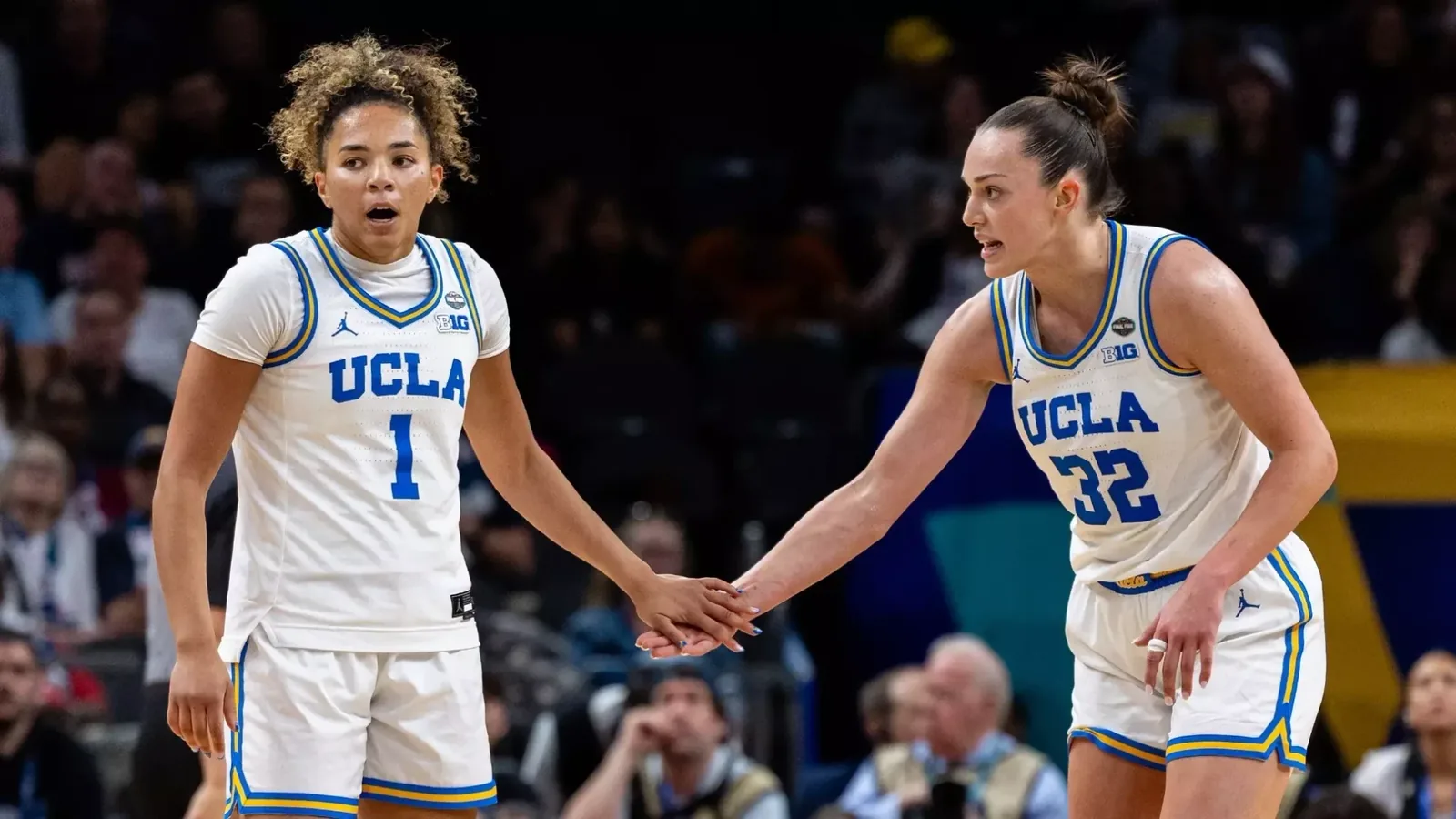
The newest entry is UCLA. The Bruins beat South Carolina 79-51 in Phoenix on April 5, 2026, finished 37-1 and claimed the program's first NCAA women's basketball crown. That result made UCLA the 17th school to win this tournament and added the 44th championship awarded since NCAA play began in 1982.
Forty-four is lower than the 45 calendar years from 1982 through 2026 because the 2020 tournament was canceled. No bracket was completed and the NCAA did not designate a champion. A top ranking, strong record or hypothetical favorite cannot fill that blank row.
Record holder
UConn: 12
Runner-up
Tennessee: 8
Latest champion
UCLA: 2026
“NCAA championship” is the controlling phrase. UCLA also won the 1978 AIAW national tournament, so its athletics history calls 2026 the program's second national title overall. For an NCAA-only comparison, UCLA has one. Keeping the governing organization in the label makes that statement compatible with UConn's 12 and Tennessee's eight.
NCAA women's champions by year from 1982 through 2001
The first two decades move from early parity into the rise of Tennessee and UConn. Louisiana Tech won the inaugural NCAA tournament, USC became the first repeat winner, and Tennessee secured six championships by 1998. The table pairs every champion with the opponent and title-game score so the record can be checked year by year.
| Season | NCAA champion | Championship game |
|---|---|---|
| 1982 | Louisiana Tech | Cheyney, 76-62 |
| 1983 | USC | Louisiana Tech, 69-67 |
| 1984 | USC | Tennessee, 72-61 |
| 1985 | Old Dominion | Georgia, 70-65 |
| 1986 | Texas | USC, 97-81 |
| 1987 | Tennessee | Louisiana Tech, 67-44 |
| 1988 | Louisiana Tech | Auburn, 56-54 |
| 1989 | Tennessee | Auburn, 76-60 |
| 1990 | Stanford | Auburn, 88-81 |
| 1991 | Tennessee | Virginia, 70-67 OT |
| 1992 | Stanford | Western Kentucky, 78-62 |
| 1993 | Texas Tech | Ohio State, 84-82 |
| 1994 | North Carolina | Louisiana Tech, 60-59 |
| 1995 | UConn | Tennessee, 70-64 |
| 1996 | Tennessee | Georgia, 83-65 |
| 1997 | Tennessee | Old Dominion, 68-59 |
| 1998 | Tennessee | Louisiana Tech, 93-75 |
| 1999 | Purdue | Duke, 62-45 |
| 2000 | UConn | Tennessee, 71-52 |
| 2001 | Notre Dame | Purdue, 68-66 |
Several quick checks expose common transcription errors. USC owns two consecutive trophies, not one shared title. Louisiana Tech's 1982 and 1988 wins both belong to the NCAA column. Tennessee's 1996, 1997 and 1998 championships form a three-peat, while the 1991 victory over Virginia is the only overtime final in this portion of the list.
UConn's undefeated 1995 team supplied the program's first championship, but the Huskies did not immediately dominate every season; Tennessee won the next three tournaments, Purdue broke through in 1999, and UConn returned in 2000. Reading the rows in order preserves that competitive rhythm better than viewing totals alone.
NCAA women's champions by year from 2002 through 2026
The next 25 calendar years include 24 champions and one cancellation. UConn won nine of those trophies, Baylor won three, and South Carolina won three. The most recent six completed tournaments produced five different champions, capped by UCLA's first NCAA victory.
| Season | NCAA champion | Championship game |
|---|---|---|
| 2002 | UConn | Oklahoma, 82-70 |
| 2003 | UConn | Tennessee, 73-68 |
| 2004 | UConn | Tennessee, 70-61 |
| 2005 | Baylor | Michigan State, 84-62 |
| 2006 | Maryland | Duke, 78-75 OT |
| 2007 | Tennessee | Rutgers, 59-46 |
| 2008 | Tennessee | Stanford, 64-48 |
| 2009 | UConn | Louisville, 76-54 |
| 2010 | UConn | Stanford, 53-47 |
| 2011 | Texas A&M | Notre Dame, 76-70 |
| 2012 | Baylor | Notre Dame, 80-61 |
| 2013 | UConn | Louisville, 93-60 |
| 2014 | UConn | Notre Dame, 79-58 |
| 2015 | UConn | Notre Dame, 63-53 |
| 2016 | UConn | Syracuse, 82-51 |
| 2017 | South Carolina | Mississippi State, 67-55 |
| 2018 | Notre Dame | Mississippi State, 61-58 |
| 2019 | Baylor | Notre Dame, 82-81 |
| 2020 | No NCAA champion | Tournament canceled |
| 2021 | Stanford | Arizona, 54-53 |
| 2022 | South Carolina | UConn, 64-49 |
| 2023 | LSU | Iowa, 102-85 |
| 2024 | South Carolina | Iowa, 87-75 |
| 2025 | UConn | South Carolina, 82-59 |
| 2026 | UCLA | South Carolina, 79-51 |
The amber row is not a missing-data placeholder. It records a historical outcome: the NCAA tournament did not take place in 2020, so the season contributes zero to every school's championship total. Removing the row entirely makes a chronological list harder to audit, while assigning a projected champion would be inaccurate.
The modern results also show why “most titles” and “current champion” are different searches. UConn strengthened its record with championship No. 12 in 2025, then South Carolina eliminated the Huskies in the 2026 semifinals and UCLA won the final. For live fixtures beyond this completed record, consult the women's college basketball schedule.
Women's NCAA championships by school
Seventeen programs share the 44 NCAA championships awarded through 2026, but the distribution is top-heavy. UConn and Tennessee own 20 between them. The next six multi-title programs combine for 15, and nine schools have one each.
| School | NCAA titles | Championship seasons |
|---|---|---|
| UConn | 12 | 1995, 2000, 2002, 2003, 2004, 2009, 2010, 2013, 2014, 2015, 2016, 2025 |
| Tennessee | 8 | 1987, 1989, 1991, 1996, 1997, 1998, 2007, 2008 |
| Baylor | 3 | 2005, 2012, 2019 |
| South Carolina | 3 | 2017, 2022, 2024 |
| Stanford | 3 | 1990, 1992, 2021 |
| Louisiana Tech | 2 | 1982, 1988 |
| Notre Dame | 2 | 2001, 2018 |
| USC | 2 | 1983, 1984 |
| LSU | 1 | 2023 |
| Maryland | 1 | 2006 |
| North Carolina | 1 | 1994 |
| Old Dominion | 1 | 1985 |
| Purdue | 1 | 1999 |
| Texas | 1 | 1986 |
| Texas A&M | 1 | 2011 |
| Texas Tech | 1 | 1993 |
| UCLA | 1 | 2026 |
The arithmetic is an important quality check. Twelve plus eight, plus nine titles from the three schools tied at three, plus six from the three schools tied at two, plus nine single-title winners equals 44. That matches the number of completed NCAA tournaments and confirms that the canceled 2020 event contributes nothing.
An NCAA article published before the 2026 bracket said 16 programs had won. It was accurate at publication. UCLA's subsequent victory created a new school-level record, so a current post-tournament table must show 17. Freshness matters even in historical content when the latest championship has just been added.
Repeat champions and the biggest title runs
USC established the first repeat in 1983 and 1984, only two years after the NCAA tournament began. Tennessee raised the standard by winning three consecutive titles from 1996 through 1998. UConn later matched that three-peat in 2002-04 and then became the first—and still only—program to win four straight, from 2013 through 2016.
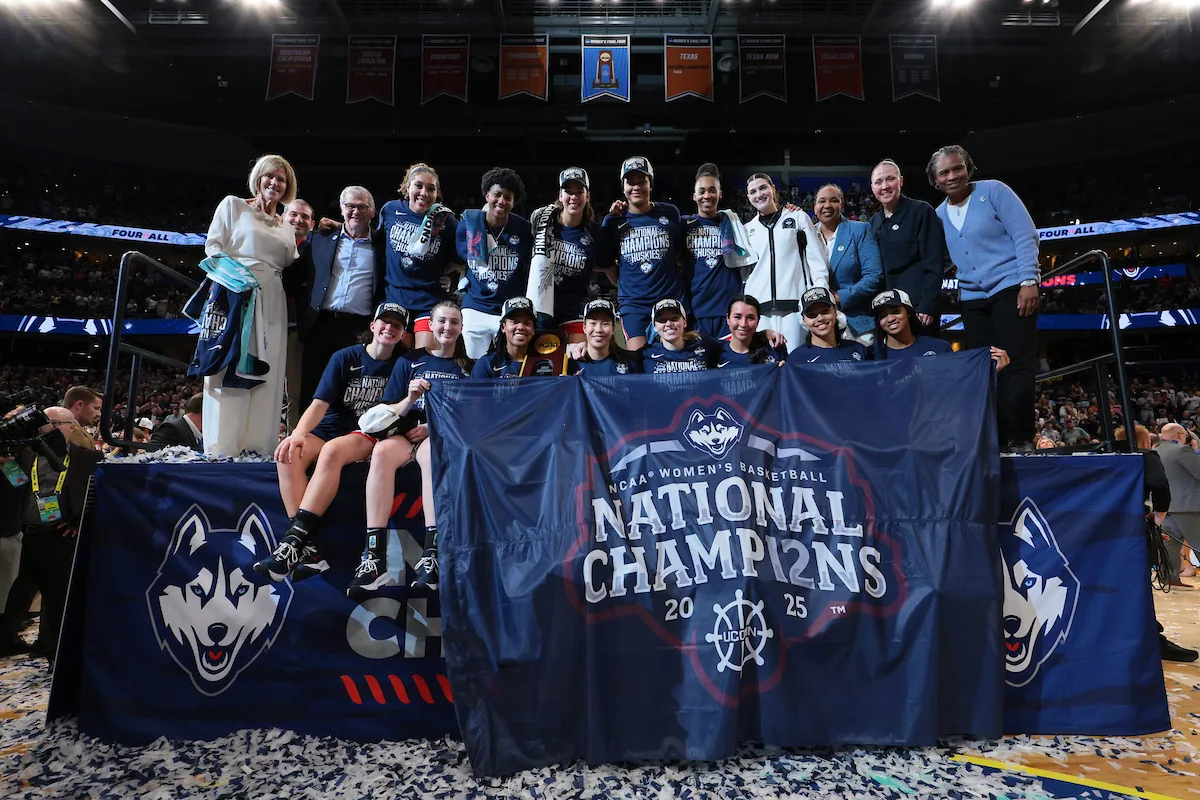
That four-peat explains only part of UConn's record. The Huskies also won in 1995 and 2000, swept 2009-10, and returned to the top in 2025. In other words, the 12 titles combine peak continuity with success across multiple roster generations. Mississippi State stopped the attempt at a fifth consecutive championship in the 2017 national semifinals, ending both the title run and UConn's 111-game winning streak.
Breanna Stewart provides a player-level marker for the 2013-16 stretch. NCAA records credit her with four consecutive championships and four Women's Final Four Most Outstanding Player awards. Those honors help describe the era, but the championships remain school trophies in this article's ranking.
First repeat
USC, 1983-84
First three-peat
Tennessee, 1996-98
Only four-peat
UConn, 2013-16
Baylor, Stanford and South Carolina each own three championships without a three-year sweep. That is why a total and a streak should be presented separately: one measures every trophy a program earned, while the other measures consecutive tournament wins.
Why AIAW titles are listed separately
Women's college basketball had national championships before the NCAA began sponsoring its Division I tournament in 1982. The Association for Intercollegiate Athletics for Women conducted championships and governed women's intercollegiate sports during much of the preceding era. Treating those achievements as nonexistent would erase important history; treating them as NCAA trophies would misidentify the awarding organization.
UCLA makes the distinction easy to see. Its 1978 championship came in AIAW competition. Its 2026 victory was the program's first NCAA title. Therefore UCLA can correctly claim two women's basketball national titles across organizations while appearing with one in an NCAA-only table.
Choose the count before comparing schools
- For NCAA championships, begin with the 1982 NCAA tournament and count only its winners.
- For AIAW championships, use the separate pre-NCAA records and label the organization.
- For all national titles, say that organizations are being combined and apply that method to every school.
The same discipline excludes unrelated postseason trophies. WBIT, WNIT and conference tournament winners are champions of their events, but not NCAA Division I national champions. Division II and Division III champions belong in their own divisional histories. A consistent category is more useful than a larger but mixed total.
When checking a future update, verify the division and year on the NCAA history page, confirm that the championship game is complete, and then add exactly one trophy to the winning school's total. Consult the NCAA records hub for pre-NCAA results, Final Four records or specialized questions. Through August 30, 2026, that process leaves the headline answer unchanged: UConn 12, Tennessee eight, and UCLA as the latest first-time NCAA champion.
A four-step audit for any championship claim
- Identify the organization. Look for NCAA, AIAW, NAIA, WBIT, WNIT or a conference name in the source. “National champion” by itself is not precise enough for a cross-school total.
- Lock the division and sport. NCAA Division I, Division II and Division III maintain separate basketball tournaments. A school's championship in another division is real, but it does not become a Division I title.
- Verify a completed final. The NCAA history table supplies the champion, team record, coach, final score, runner-up and site. A bracket preview, Selection Sunday article or ranking published before the final cannot add a trophy.
- Reconcile the school total. Add the winning year once, then compare the sum of all school totals with the number of completed tournaments. Preserve canceled years as zero-title entries.
The NCAA's historical championships dashboard adds another cross-check. Its filters cover year, division, sport, event and school, which helps when a university sponsors teams across several levels or when a broad athletics claim combines many sports. The NCAA says the dashboard is updated after the fall, winter and spring seasons, so a newly completed basketball final may appear first on the sport-specific championship page. That timing difference is a reason to compare sources, not a reason to guess.
Three questions that often produce the wrong total
Does a No. 1 final ranking count as a championship?
No. Rankings describe poll opinion at a point in time. The NCAA Division I champion is the team that wins the national tournament.
Does a runner-up finish add to the school total?
No. The history page records the runner-up for context, but only the winner receives the championship credited in this ledger.
Can a school report more national titles than this table?
Yes, if its own figure combines AIAW, NCAA or other recognized competitions. The statement should identify that broader scope. An NCAA-only comparison must return to the 1982-forward NCAA rows.
This method is deliberately conservative. It may produce a smaller number than a promotional school biography, but it gives every program the same treatment. Readers can still honor the AIAW pioneers, examine a separate pre-NCAA results book and recognize other postseason winners without blending unlike trophies into one NCAA ranking.
Publication dates also matter during championship week. A pre-tournament NCAA preview can be fully accurate when it says 16 schools have won, yet become incomplete when a 17th school wins days later. Keep the preview as historical context, but let the completed final and updated championship-history row control the current total. Record the verification date so another editor knows whether the newest spring-season dashboard refresh was already available.
Use the narrowest authoritative source for each field. The sport history page controls the winner and final score; the women's records hub routes specialized questions to tournament, coaching, attendance or pre-NCAA books; the cross-sport dashboard checks broader school totals. If two pages appear different, compare their scope and update dates before treating the difference as an error. This source hierarchy keeps a routine annual update from rewriting unrelated history.
Sign in with Google to join the discussion.