Why the whistle now comes when the shot clock reaches 19
For the 2026-27 NCAA men's basketball season, officials have been instructed to call a ten-second backcourt violation when the shot clock reaches 19 seconds rather than 20 in the familiar sequence that begins with a fresh 30-second clock. The NCAA says the adjustment better aligns administration with clocks that measure tenths of a second. It has not renamed the rule or granted teams eleven seconds to cross half court.
The change appeared in the NCAA's May 8 rules announcement and is repeated in its October 1 2026-27 table crew reference sheet. That matters for viewers using last season's shorthand. A crowd counting down to 20, or a commentator expecting the whistle at that number, may be applying the old visual cue.
A display adjustment, not an eleven-second rule
The number shown on a clock is a display of a running interval, not an independent explanation of every fraction already elapsed. Simply subtracting the two visible integers can obscure how the equipment displays the time between them. The NCAA's instruction gives officials the applicable cue; it should take priority over a fan's assumption about rounding on a particular television graphic.
Imagine a hypothetical Duke possession against full-court pressure. The ball is inbounded into the backcourt, the shot clock begins properly at 30 and the offense remains in continuous control there. The relevant new cue is 19. This example assumes no intervening whistle, no change of control and no unusual starting clock. Alter any of those facts and a viewer may need more information than the current number alone.
That last qualification explains much of the apparent inconsistency. A ten-second count is tied to the team's backcourt situation, while the shot clock serves the broader possession. They commonly begin together on a fresh backcourt inbound, but they do not have to share the same starting point in every play. A later section examines that distinction without pretending every backcourt possession must end at 19.
For players, the practical instruction remains straightforward: advance the ball promptly and establish frontcourt status before the count expires. A guard should not build a press break around debating the final displayed digit. The valuable adjustment for fans is equally modest: update the visual cue while continuing to watch control, court position and interruptions. Those facts determine whether the cue actually applies.
What must reach the frontcourt before the count expires
The offense must establish the ball's frontcourt status in time. A player looking beyond the center line, leaning his shoulders across it or releasing a hopeful pass is not a substitute for the rule's court-contact requirements. That is why the final instant of a press break can be harder to judge from a tight television angle than it first appears.
Dribbling across the division line
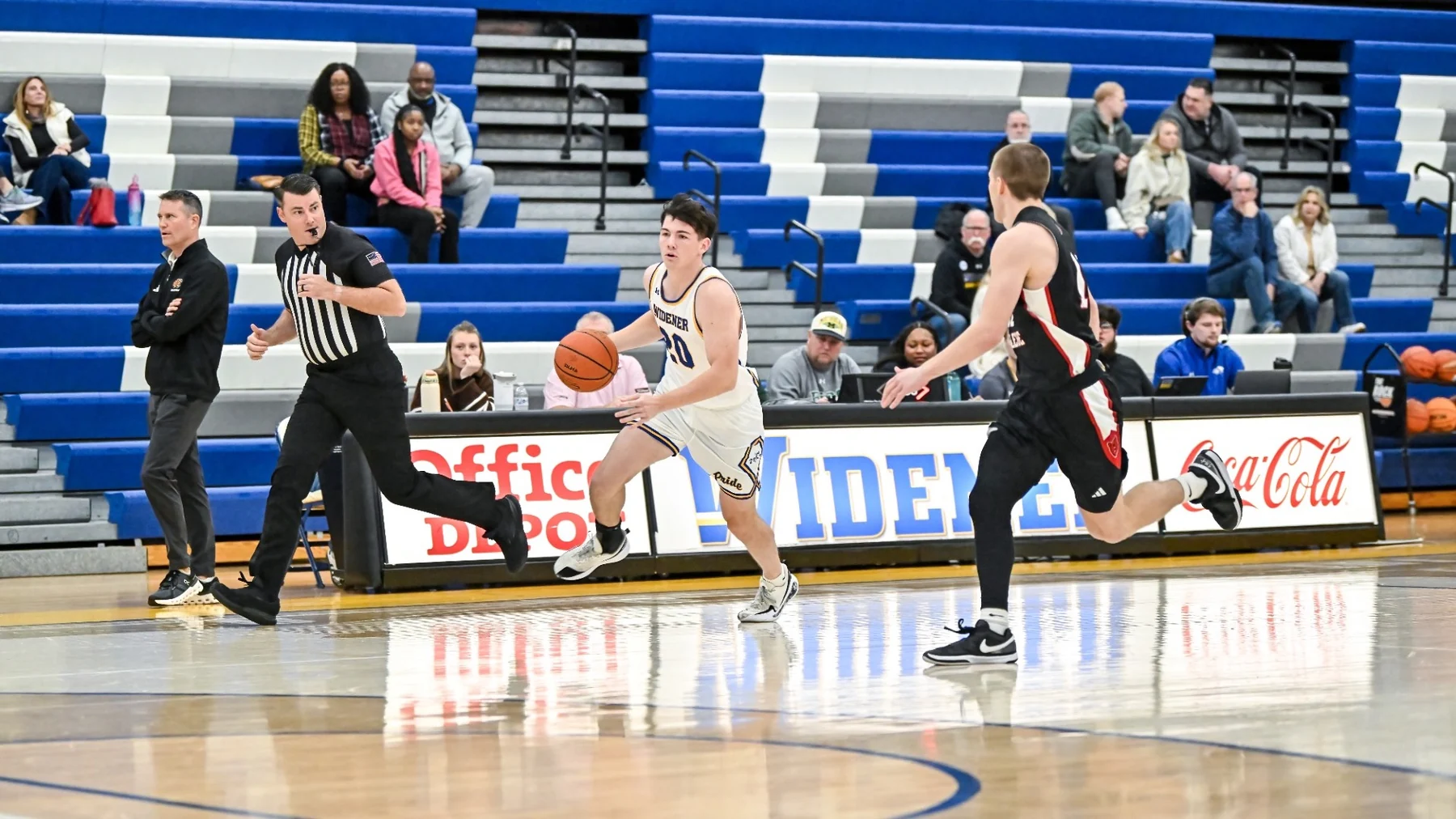
For a dribbler, both feet and the ball must contact the frontcourt. Watch all three rather than only the guard's upper body. A foot can still be on the backcourt side while the ball bounces ahead, or the player can step forward while the ball remains behind. A camera following the face or the nearest defender may conceal the relevant contact.
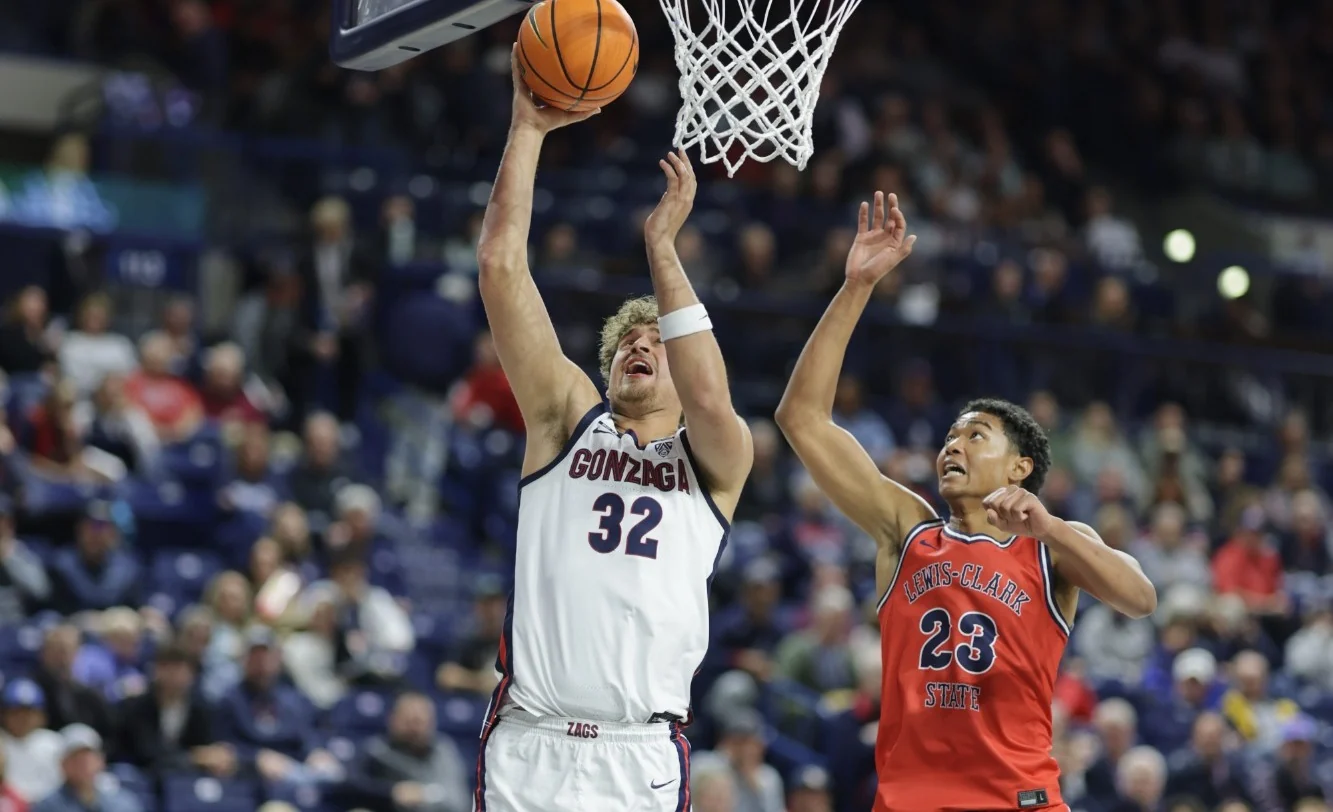
Picture a hypothetical Gonzaga guard squeezed toward the sideline. He turns his shoulders away from the trap and stretches a dribble toward half court. That movement may create a passing angle, but a viewer still has to check the feet and ball to decide whether frontcourt status has been established. The rule rewards actually completing the advance, not appearing close enough from the broadcast's perspective.
This also explains why the division line itself matters. The rulebook treats it as part of the backcourt, apart from its defined mathematical edge. For ordinary viewing, the safe takeaway is that standing on the line is not the same as having completed the dribble into the frontcourt. Coaches want a clean crossing with room to operate, especially when a second defender is waiting to trap.
A pass still in the air
The men's casebook supplies a direct example: a player passes toward a teammate in the frontcourt, but the count expires while the ball is airborne. The ruling is a violation. This is not the same as a field-goal attempt that only needs to leave the shooter's hand before a horn under the applicable shooting rule.
In practical terms, a long diagonal outlet can beat a trap only if it completes the required advance in time. Releasing it at the last possible moment introduces flight time and interception risk. A more useful analysis asks whether the offense offered an earlier middle outlet, whether the inbounder became a return option and whether the receiver moved into an accessible position.
None of that requires blaming a particular guard from one replay. The passer may have been late, but teammates may also have failed to show an outlet. Following the entire sequence gives a fairer basketball explanation than freezing the ball just after it leaves the hand and assuming the team has already escaped.
Deflections and stoppages do not all restart the count
The most useful follow-up to “why 19?” is “what happened before this number appeared?” A whistle can stop the clocks without giving the offense a new ten-second period. A defender can touch the ball without ending the offense's control. Watching only the latest inbound misses that history.
A touch without a change of control
The men's casebook describes a ball handler under pressure when a defender knocks the ball away and the same offensive player retrieves it. Because there has been no change in team control, the backcourt count continues. A fingertip on a pass is therefore not automatically a fresh possession.
For a hypothetical Arkansas press, that means a useful deflection can do two jobs: disrupt the advance and consume more of the offense's remaining time. If the offense recovers, it still needs an outlet quickly. Fans should distinguish that sequence from a defender actually securing control and then losing the ball back. Those are different possession facts.
Out of bounds and the possession arrow
Under Rule 9-10, the count does not reset simply because the defense causes the ball to go out of bounds. Nor does it reset when the offense retains possession after a held ball. A team that has already spent much of its allowance cannot assume that a fresh throw-in creates another full ten seconds.
That gives pressure a value beyond steals. A defender who forces a difficult save, a deflection out of bounds or a held ball can leave the offense needing to execute another inbound with little time to advance. The correct basketball question is how much of the count remains, rather than whether the offense still owns the ball.
The timeout exception and its limits
In the men's game, a proper charged timeout by the offense resets the backcourt count. The casebook contrasts that with a defensive timeout or media timeout following a defensive deflection out of bounds: those do not buy the offense the same reset. Timeout ownership matters, not just the fact that everyone spent a minute near the bench.
A reset of the backcourt count also should not be confused with a new 30-second shot clock. The two serve different purposes. A team may gain a new allowance to advance while still working with the remaining possession time shown on the shot clock under the applicable reset rules.
There is an important limit: the casebook says an excessive timeout that produces an offensive technical foul does not rescue the backcourt count. Likewise, a timeout request cannot undo a violation that has already occurred. The practical lesson is to recognize pressure early, know the available timeout resources and avoid turning a manageable trap into a last-instant rules dispute.
Why the shot clock cannot always tell the whole story
There are three related measurements on a possession: time remaining in the half, time available for the shot and time used in the backcourt. They answer different questions. Treating them as interchangeable is a common reason a perfectly reasonable explanation of one play becomes wrong when applied to the next.
The standard 30-to-19 example assumes the relevant clocks begin together. The casebook also describes an inbound touched by a defender in the frontcourt before the ball reaches an offensive player in the backcourt. In that sequence, the shot clock has already started before the relevant backcourt count begins. The number visible when the offense first touches the ball in the backcourt therefore matters.
This is why a fan should be cautious about a cropped clip that begins after the first touch. Without the inbound and deflection, it may be impossible to reconstruct the starting point. Saying “the clock is below 19, so it must be a violation” skips the very facts that explain the play. The ordinary cue is useful; it is not a universal verdict for every possession.
The same principle applies after a stoppage. First establish whether the ten-second count was reset under the men's rule. Then check what happened to the shot clock. A timeout can change the backcourt-count situation without automatically providing a new full shot-clock period. Looking only at the number after the timeout can conceal that difference.
Late in a half, the visible shot clock may not be available in the usual way. The men's rulebook instructs officials to use a visible ten-second count when there is no visible shot clock. Fans should not conclude that the backcourt restriction disappears because a television graphic omits one of the clocks or the possession begins with little game time remaining.
A useful viewing habit is to narrate the sequence in plain basketball terms: inbound touched, team control retained, ball still in backcourt, defender deflects, whistle, offense keeps possession. That account is more informative than a string of numbers detached from the ball. It also reveals what a replay needs to show before anyone can confidently assess the call.
For a hypothetical Gonzaga inbound that caroms off a defender before reaching a guard, the question is therefore not merely whether the guard crossed before a familiar digit. It is when the relevant count began and whether it continued uninterrupted. The official documents provide the governing mechanics; the full play supplies the facts needed to apply them.
What the rule means for a press and a press break
A press can produce value without producing an immediate steal. It can make an offense use time, force a timeout or begin its half-court attack late. The ten-second restriction gives that pressure a concrete deadline. The new display cue changes how viewers recognize the deadline; it does not remove the underlying contest over space and decisions.
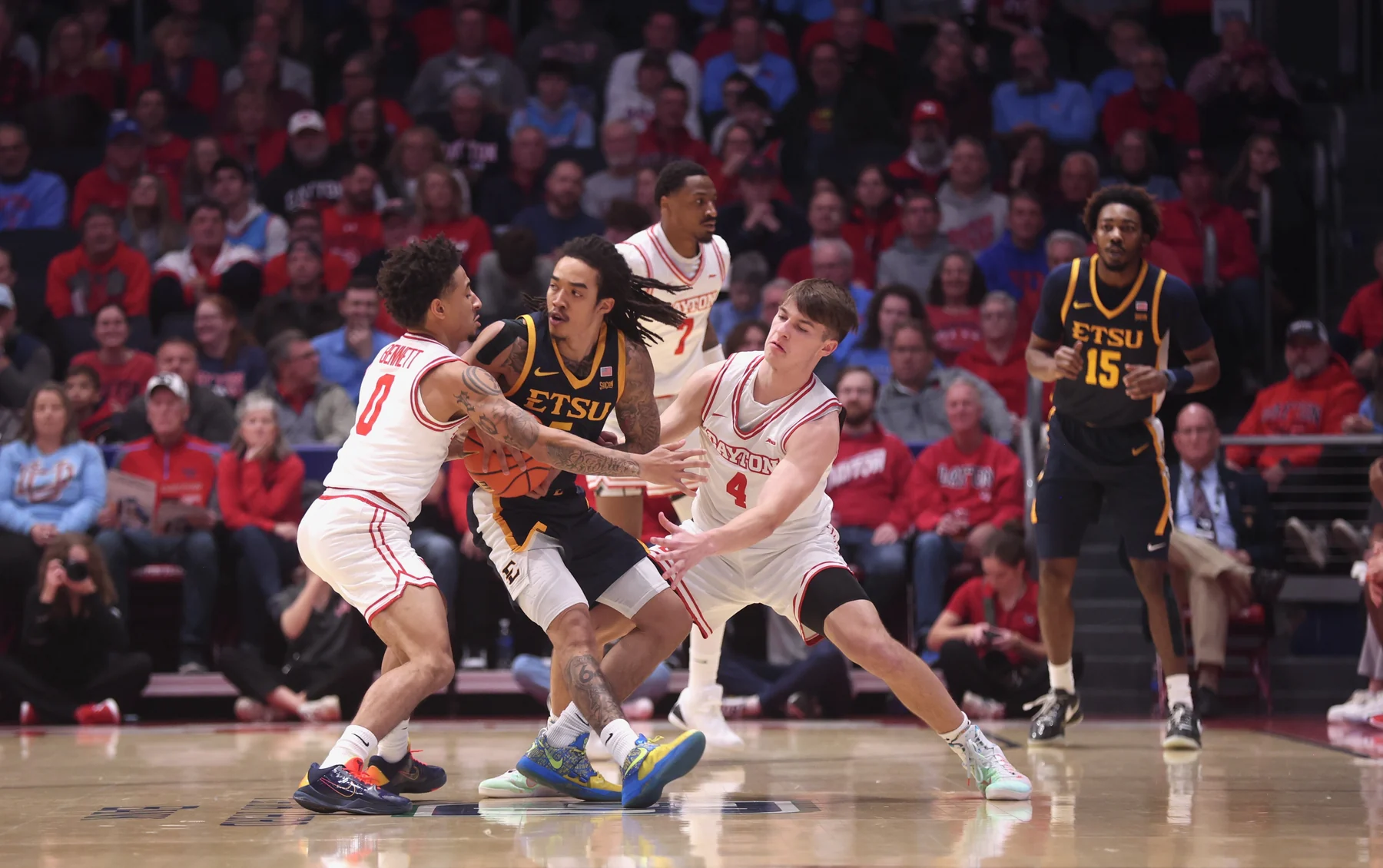
Dayton's 88–71 win over East Tennessee State on December 2, 2025 supplies a useful historical example of disruptive defense. The official recap records 22 ETSU turnovers and 14 Dayton steals. Those totals are not a count of ten-second violations, and a 2025 result cannot demonstrate the effect of a 2026 interpretation. They show why the broader possession battle deserves attention alongside one particular whistle.
Evaluate the possession before celebrating the trap
For the defense, the first trap must connect to the players behind it. Two defenders surrounding the ball can still give up an easy advance if the middle is unprotected. A deflection is useful, but reaching recklessly can produce a foul or an open passing lane. The best outcome depends on coordinated pressure, not simply how loud the crowd becomes near half court.
For the offense, a second ball handler and an accessible middle outlet can be more valuable than an ambitious solo dribble. Passing out before the trap closes lets teammates attack the space the defenders have left. Dribbling directly toward a sideline can reduce those options and force the guard to stop with poor sightlines.
Crossing half court is only the first objective. If the press break ends with a rushed, low-quality shot, the offense has escaped the violation but may still have played the possession on the defense's terms. A fan evaluating the response should watch the next pass, the number of defenders behind the ball and whether the team can organize a useful attack.
These are tactical considerations rather than claims about any team's fixed identity in 2026-27. Personnel, opponent and game state change what pressure makes sense. A lineup with several comfortable passers may handle a trap differently from one relying on a single guard. Understanding the count helps explain the urgency, while watching all five offensive players explains whether the solution was available.
How to judge a disputed call on the broadcast
Begin with the full possession. Find the inbound or other event that started the relevant count, then follow control and court status. A replay that starts with the guard already dribbling near half court can be excellent television but incomplete evidence. Before deciding the officials missed a violation, establish what happened outside that clip.
Next, distinguish the official timing equipment from the broadcast presentation. A network graphic is helpful, but it should not be treated as an independent authority over the arena's clocks and the officials' administration. If the replay shows an apparent discrepancy, the useful question is whether a timing mistake occurred, not which screenshot attracts more agreement online.
- Was this a fresh 30-second backcourt sequence? If so, remember the new 19-second cue.
- Did the ball gain frontcourt status? For a dribbler, examine the feet and ball; for a pass, do not stop at release.
- Was control interrupted by the opponent? A touch and an actual change of control are different.
- Did a stoppage reset the count? The reason for the whistle and the team charged with a timeout can matter.
- Is the dispute about the call or about replay procedure? Those questions have separate rules.
The NCAA's challenge system is not a promise that any disputed basketball event can be reviewed whenever a coach asks. Its permitted categories and procedures matter. Our coach's challenge explainer covers that separate framework. Avoid assuming a ten-second controversy must be handled exactly like an out-of-bounds challenge simply because both involve a monitor.
In a hypothetical one-possession game late in the second half, the offense may need to spend a timeout to escape pressure before the count expires. The viewer should follow the request and the whistle in sequence. A valid timeout cannot be treated as a time machine that erases a violation already completed. Equally, a crowd reaching its own spoken “ten” does not override the official starting point and mechanics.
This men's basketball explainer was checked against NCAA materials on October 30, 2026. Women's basketball, high-school basketball and professional leagues have their own provisions, so do not carry the men's timeout or count-reset explanation across those boundaries without checking. For this season's standard NCAA men's sequence, the central update is clear: watch for 19, while still watching the whole play.
Sign in with Google to join the discussion.