How many NAIA basketball teams are there?
For the completed 2025–26 season, the official NAIA statistics indexes contain 222 men's team-statistics entries with reported games and 225 women's team-statistics entries with reported games. We counted those records independently on October 14, 2026. They are a dated statistical reference, not an NAIA-certified sponsorship total for the upcoming 2026–27 season.
That qualification belongs beside the number. A database can contain an unused team record, an opponent from another association or a preseason template without establishing an active NAIA basketball program. For this completed-season count, we used each sport's season-specific team index and included records reporting at least one game. The men's index contains one additional record without reported games, which is excluded.
| What is counted | Reference period | Count |
|---|---|---|
| Men's team records with reported games | 2025–26 | 222 |
| Women's team records with reported games | 2025–26 | 225 |
| NAIA member institutions across all sports | 2026–27 list, modified September 17, 2026 | 233 schools |
Teams, schools and championship places are different counts
The 2026–27 membership document lists 233 institutions. That is an association membership figure across sports. It must not be substituted for either basketball team's total. A member can sponsor other sports without sponsoring NAIA basketball, and a school with men's and women's programs contributes one team to each separate sport list.
A championship field is a third population. It selects teams from the wider basketball landscape rather than admitting every program. The number of places in March therefore cannot answer how many schools field basketball teams during the season. A men's bracket and a women's bracket also remain separate competitions even when their field sizes match.
For a current school search, use the member list together with the team's basketball schedule and its conference page. Do not describe an upcoming season's unplayed statistics templates as a completed census. The practical goal is to identify the program that is actually playing, with the correct association, gender and season attached.
The men's 2025–26 statistics index and women's 2025–26 statistics index are the sources for the counted reference above. A reported-games count describes the database entries with submitted activity; it does not independently certify every membership or sponsorship requirement. Keep that narrower definition when comparing it with a recruiting directory or a future official projection.
Finding the men's and women's NAIA basketball programs
Begin with the NAIA school gateway and its linked membership document, then confirm basketball on the school's athletics site. A member institution is your starting point, not proof that every sport at that institution plays in the NAIA. The sport page and season schedule establish the basketball program you are looking for.
Keep the full school name, location and gender together. The official member list includes Bethel College in Kansas, Bethel University in Indiana and Bethel University in Tennessee. A result shortened to Bethel basketball can therefore refer to three different campuses. Similar ambiguity occurs with Saint Francis, Columbia and other repeated names. A location check takes seconds and prevents following the wrong roster.
Men's and women's teams also deserve separate searches. Dordt's official January 2026 previews for games against Morningside illustrate this clearly: the school published separate men's and women's previews for the January 14 fixtures. Both concerned the same campus and conference relationship, but they covered different teams, opponents' records and basketball matchups.
For a family or local fan planning to attend, a possible doubleheader is useful context. Confirm the order and start times on the host's actual schedule rather than assuming the women's game always comes first or that one ticket covers the entire evening. The calendar can answer a practical question that a national directory cannot.
For research, the NAIA's sport hubs connect to statistics, polls, championship resources and record material. The men's basketball hub and women's basketball hub are separate entry points. Use the season selector when opening the statistics provider, and make sure the team page you find belongs to the season you intended.
An archived roster remains useful for a player's historical role but cannot certify that the same player is currently enrolled, eligible or in the rotation. Likewise, an old conference standings page is evidence of the completed season it names. Preserve the year when recording a fact, especially when a school has changed associations or conferences.
A short list of relevant programs is often more useful than a national total. Start with a region you can attend or a league whose games you can watch, then examine several teams' schedules. The national reference tells you the scale of the association's basketball activity; the school pages turn that reference into a specific game, campus and team to follow.
Conferences give the NAIA season its shape
Conferences organize much of the basketball that a local fan sees week after week. Their schedules bring familiar opponents back to campus, their standings track the league race, and their postseason events connect the regular season to national qualification. Learn the relevant league before trying to compare every NAIA team nationally.
Start with a league and its current standings
The official statistics site's completed-season conference filter includes leagues such as the Crossroads League, Great Plains Athletic Conference, Cascade Collegiate Conference, Heart of America Athletic Conference, Kansas Collegiate Athletic Conference, Mid-South Conference, Sooner Athletic Conference and Southern States Athletic Conference. These names are starting points for a search, not a guarantee that every school appearing in an old table remains a member.
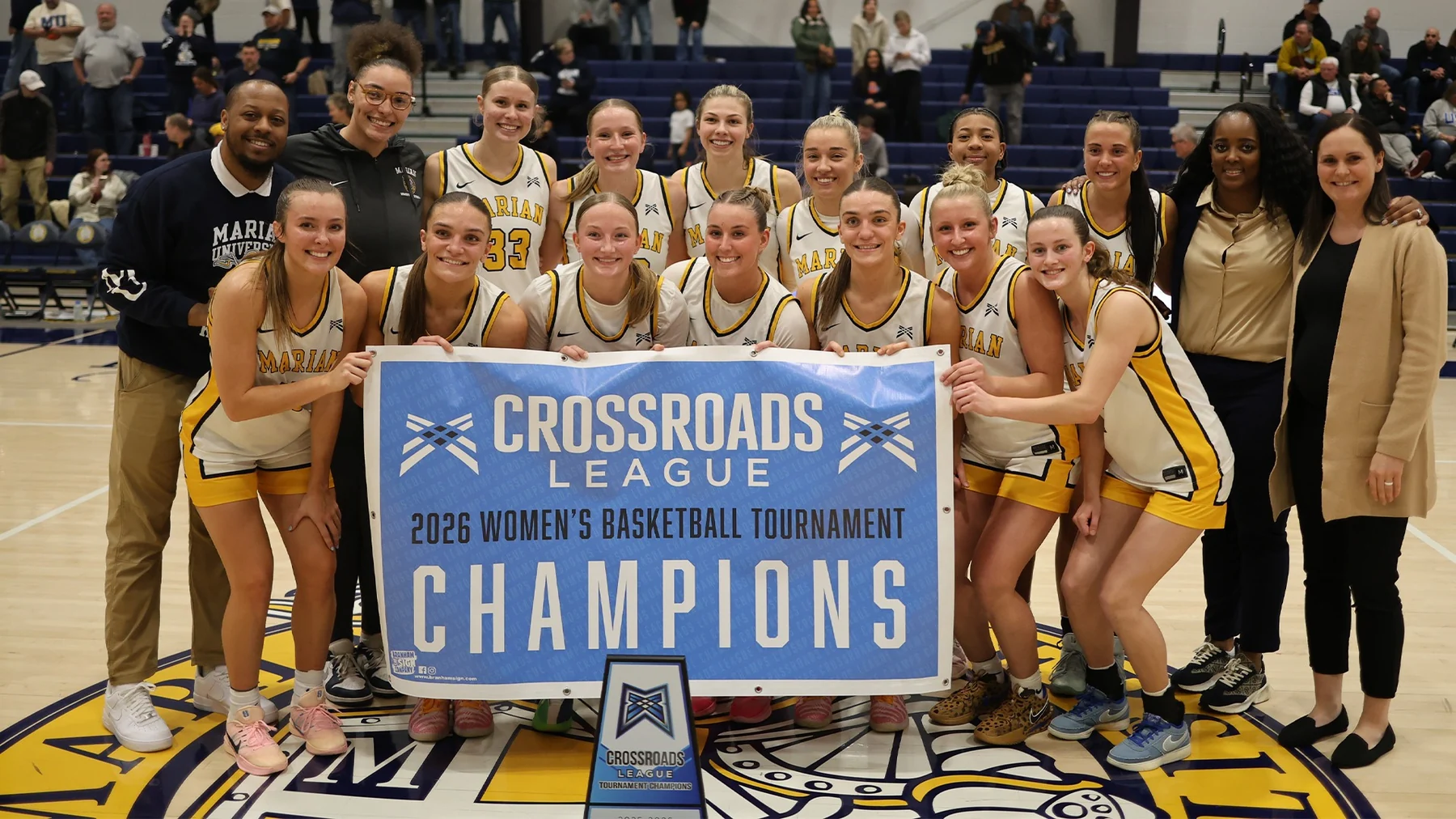
Marian's women won the Crossroads League tournament championship in March 2026. That is a specific league accomplishment; it should not be confused with the later NAIA national championship or with a recruiting service's ranking of desirable colleges. A fan tracking the season needs to identify which competition an award, record or result describes.
The same care applies to conference names. The GSAC changed from Golden State to Great Southwest Athletic Conference in 2024 while retaining its initials. A historical article using Golden State can be accurate for its period, while the current conference page uses Great Southwest. Preserve the season rather than treating the naming difference as proof that two unrelated leagues are involved.
When reading standings, compare the conference record with the overall record. The former isolates league games; the latter adds nonconference opponents. Two teams with the same overall win total can have reached it against very different schedules. Shared opponents and home/away results provide more useful comparison than the total alone.
What independent status means for a team search
A program outside a conventional conference schedule does not automatically have no national-championship route. The NAIA coaches manual explicitly addresses conference, Continental Athletic Conference and qualifying-group competition. Those structures need to be checked for the actual team and season rather than replaced with an assumption that an independent label settles eligibility.
For following games, this means you may need more than one page: the school's schedule, the applicable qualifying event and the NAIA championship announcement. A program's opponents can span several leagues even when its postseason route uses a different grouping. The regular-season calendar and the qualification arrangement answer related but separate questions.
Keep men's and women's membership checks separate here as well. An all-sports conference directory helps locate institutions; a basketball standings page identifies that sport's current participants. The closer the question gets to a specific game or postseason place, the more useful the sport-specific source becomes.
How the NAIA basketball championship works
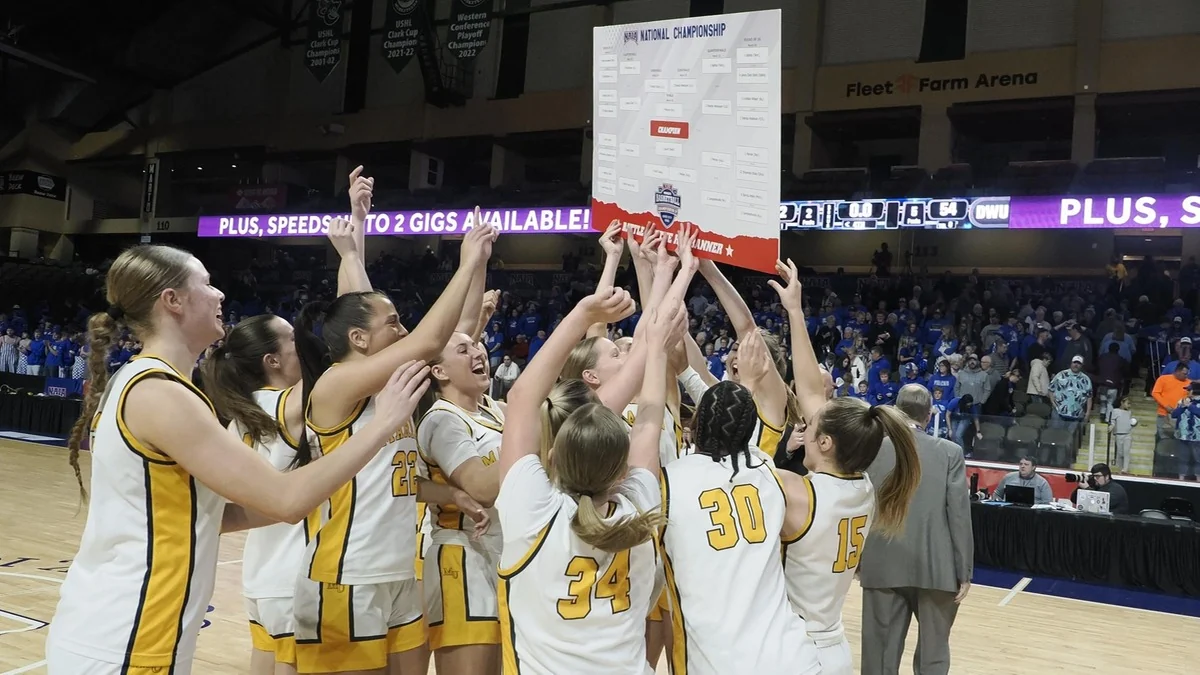
The NAIA championship is its own national tournament. Qualification leads into a bracket, then winning advances a team through that bracket. A statistical team index, a conference title and a national championship appearance describe different achievements. Read the actual qualifier announcement before placing a team in the field.
Opening rounds and the final-site bracket
The published 2026–27 men's and women's coaches manuals describe 64-team national championship fields beginning at 16 four-team sites. A team must win twice at its opening site to join the 16-team final-site bracket. The remaining rounds are single elimination: four more wins take a final-site entrant from the round of 16 to the national title.
The current manuals schedule the first and second rounds for March 12–13, 2027, with final-site competition March 18–23. The men's final site is Municipal Auditorium in Kansas City, Missouri. The women's final site is the Tyson Events Center in Sioux City, Iowa. These are published manual dates checked October 14, 2026; confirm the final bracket and game schedule before making attendance plans.
The cities are easy to confuse when someone shortens a search to NAIA basketball championship. Kansas City and Sioux City refer to different final-site competitions. Neither name means that all 64 teams start there. The opening-site assignment determines where a qualifier first plays and whether its supporters will be traveling before the final rounds.
For fans, the format makes the early weekend consequential. A nationally strong team can be eliminated before reaching the familiar final venue. Its season does not become less real because it never appears in that venue's round-of-16 schedule. An opening-round result and a final-site result should therefore be labeled accurately in any recap or record discussion.
The short turnarounds also create concrete basketball questions. Does the rotation have another ball handler if the starting guard picks up early fouls? Can a team protect the defensive glass without overextending its main interior player? Those are useful things to watch in the specific matchup, rather than assuming a national ranking alone predicts how a team handles successive tournament games.
For travel, wait until the site and session are confirmed. A championship guide can explain the structure months ahead, but it cannot promise which campus will host a particular team or when its first game tips off. Buy for the actual event and read the venue's instructions, especially if several games share one session.
The official men's manual and women's manual keep the two competitions separate. Their bracket framework is more useful than inferring postseason access from the size of the association or from the number of reported-statistics entries in a completed season.
NAIA basketball is a separate association from the NCAA
The NAIA is not a fourth NCAA division. It is a separate association with its own member institutions, eligibility administration, championships and statistical records. A team can play a nonconference opponent from another association without changing its own classification or merging the two organizations' championship fields.
Historical labels require particular care. The NAIA previously had separate Division I and Division II basketball competitions, then combined its basketball divisions beginning in 2020–21. Those older NAIA labels do not mean NCAA Division I or NCAA Division II. A result described as an NAIA Division II championship belongs to the NAIA's historical structure.
The playing rules provide an example of shared practice without shared membership. The current NAIA men's coaches manual uses NCAA men's basketball rules unless a manual provision says otherwise. That makes many on-court situations familiar to an NCAA viewer. It does not make the team's national tournament an NCAA event or transfer its records into an NCAA division.
John Pierce's 4,230 points at Lipscomb from 1990 through 1994 illustrate the record distinction. His extraordinary total belongs to an NAIA college career. Lipscomb's later NCAA identity does not retroactively turn his games into NCAA Division I games. A school's current division and the classification of a player's historical career are separate facts.
That is why our NCAA Division I men's career scoring guide has a narrower scope than an all-college comparison. Both can be useful, but they answer different questions. Adding NAIA totals to a Division I table without labeling them would change the category while leaving the headline misleadingly intact.
A similar distinction applies to rankings. A recruiting service's college-fit list may consider academics, cost or preferences, while a basketball poll concerns competitive standing within a defined voting system. Neither is an automatic conversion chart between NAIA, NCAA D2 and NCAA D3 teams. The association label alone cannot tell you how two particular lineups would match up.
For a cross-association game, assess the actual basketball. Which team can handle pressure, protect the rim and create quality shots against that opponent? Who has enough experienced ball handlers to avoid empty possessions? These are matchup questions to investigate through rosters, box scores and game reports. A blanket claim that every team in one association beats every team in another goes beyond that evidence.
Keeping the labels precise helps a fan discover NAIA basketball on its own terms. Its league rivalries and national championship have their own history. You do not need to misclassify the programs as NCAA schools to understand why their games and records matter.
Keeping a NAIA team list useful through the season
A program list is most useful when it leads to a reliable current calendar. Save the school's official athletics site, the basketball season page and the relevant conference page. Recheck those sources when a game approaches rather than using a membership document as though it were a fixture feed.
Membership changes need effective dates
The NAIA's announcement of six incoming members for 2026–27 shows why school additions cannot be added blindly to a basketball count. Andrew College, Champion Christian and Georgia Southern's East Georgia Campus were described with men's and women's basketball among their sports. Nevada State's announced sports did not include basketball. A new member can increase association membership while making no immediate addition to a particular basketball list.
That is also why a new membership document cannot automatically update the completed-season statistics reference. The reference remains attached to reported activity in 2025–26. A new team entering in 2026–27 belongs to a different season, and a departure can remove a current program while leaving its historical statistics intact. Keep the two populations distinct.
When a move is announced, read both the announcement date and the effective season. Confirm which sports enter the new arrangement and whether any approval or eligibility conditions remain. A prospective conference arrival and a completed change are different facts. The most precise wording is usually the school's own description of the stage it has reached.
Use the host's game links for watching and attendance
For a specific fixture, the host school's page is the useful source for ticketing, venue and video. The Marian women's season schedule illustrates the team-level page to open after finding a program. Its game entries connect the season's dates with opponents and event information.
Do not assume that every regular-season game shares the national championship's broadcast arrangement. A road game can use the opponent's platform. A campus doubleheader can have its own ticket and session rules. Follow the link for the actual game, check whether it is live or an archive, and confirm access terms before start time.
After watching, use the box score to frame the next game. Check whether turnovers removed scoring opportunities, offensive rebounds extended possessions or foul trouble changed the rotation. Those details explain more about a particular team than its place in an association-wide program count. They are a starting point for analysis, rather than proof that one statistical category caused the result.
As the conference race develops, follow the applicable qualifying event and the official national-field announcement. This keeps the information chain clear: identify the school, confirm the basketball program, follow its games and then verify its postseason place. A carefully dated count is a useful reference at the beginning of that process; the current team and league pages do the work during the season.
Sign in with Google to join the discussion.