The quick answer: titles and wins are different records
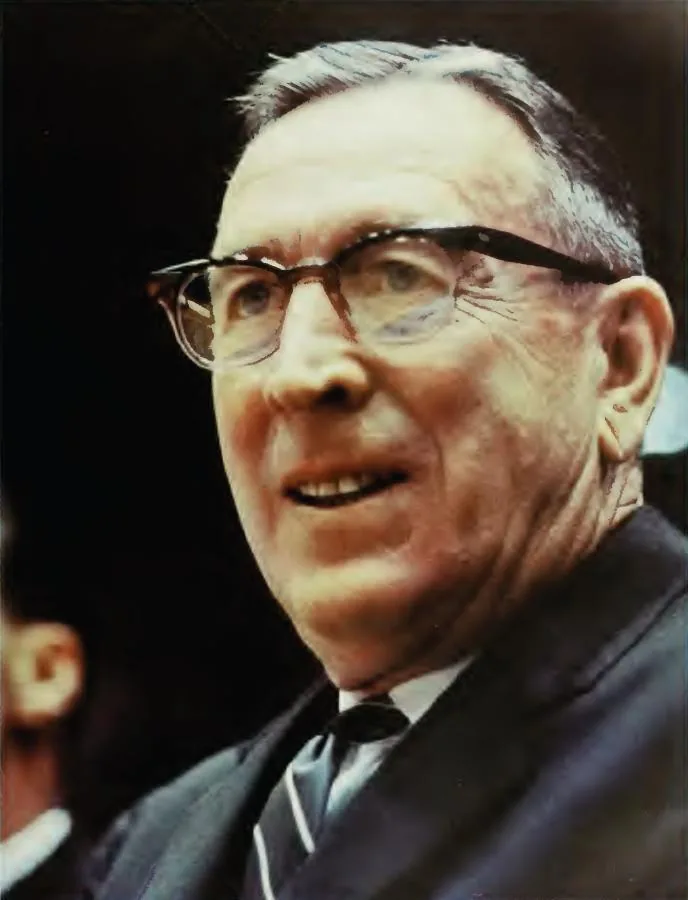
There is no single correct name until the question defines its category. For NCAA Division I men's basketball, John Wooden owns the coaching record with 10 national championships at UCLA. Mike Krzyzewski owns the official men's career-victories record with 1,202 wins across Army and Duke. Those are different achievements, and neither number should be substituted for the other.
Men's NCAA titles
10
John Wooden, all at UCLA from 1964 through 1975.
Men's career wins
1,202
Mike Krzyzewski, in the NCAA men's coaching record book.
All Division I basketball
1,288
Geno Auriemma's UConn career total through 2025-26.
The distinction starts with what is being counted. A national championship requires winning the NCAA tournament in one particular season. Career wins include the rest of the schedule too: nonconference games, league games, conference tournaments and postseason games over an entire head-coaching career. One metric emphasizes the highest possible finish; the other combines performance with opportunity and longevity.
The wording also determines whether women's basketball belongs in the answer. Auriemma's updated UConn biography lists 1,288 victories and 12 NCAA women's championships through the 2025-26 season. Therefore, “Who has the most in men's Division I?” and “Who has the most in Division I college basketball?” are not interchangeable questions. This guide leads with men's records because that is the dominant search intent, then makes the women's and combined-category answer explicit.
Use this one-sentence rule
Name the gender, division, metric and cutoff date before naming a record holder. If any of those four labels is missing, the answer may be technically true in one table and misleading everywhere else.
Current games are a separate task from historical records. To move from these career totals to this season's dates and matchups, use the men's college basketball schedule.
Men's coaches with the most NCAA championships
The cleanest men's leaderboard counts NCAA Division I tournament championships credited to a head coach. It does not count conference tournament titles, regular-season league crowns, Final Four appearances or championships claimed by another selector before the NCAA tournament began in 1939. On that basis, Wooden's 10-title lead is twice Krzyzewski's total.
| Rank | Coach | NCAA titles | Championship school(s) | Title years |
|---|---|---|---|---|
| 1 | John Wooden | 10 | UCLA | 1964, 1965, 1967-1973, 1975 |
| 2 | Mike Krzyzewski | 5 | Duke | 1991, 1992, 2001, 2010, 2015 |
| 3 | Adolph Rupp | 4 | Kentucky | 1948, 1949, 1951, 1958 |
| T-4 | Jim Calhoun | 3 | UConn | 1999, 2004, 2011 |
| T-4 | Bob Knight | 3 | Indiana | 1976, 1981, 1987 |
| T-4 | Roy Williams | 3 | North Carolina | 2005, 2009, 2017 |
The ten coaches with two recognized men's titles
Denny Crum, Billy Donovan, Dan Hurley, Henry Iba, Ed Jucker, Branch McCracken, Bill Self, Dean Smith, Phil Woolpert and Jay Wright. Hurley is the newest member of this group after UConn's 2023 and 2024 repeat.
Recent champions did not alter the top of the ranking. Todd Golden won his first title with Florida in 2025, and Dusty May won his first with Michigan in 2026. They belong in the complete champion-coach history, but a table limited to multiple winners properly begins at two.
Rick Pitino requires a record-book note. He coached Kentucky's recognized 1996 champion and Louisville's on-court 2013 winner. The NCAA championship history displays Louisville with an asterisk because its tournament participation was later vacated. For an adjusted NCAA-title count, this guide does not place Pitino in the two-title row. A narrative about games played on the court can mention both runs, but it must also state the vacatur.
The same discipline applies to 2020. The tournament was canceled because of COVID-19, so there was no NCAA men's champion and no title to credit to a coach. “No champion” is not the same as a vacant championship caused by a later enforcement action.
How John Wooden built a 10-title record
Wooden did not spread ten championships evenly across a long career. The breakthrough arrived in his 16th UCLA season, when the 1963-64 Bruins finished 30-0. UCLA repeated in 1965, missed the tournament in 1966, then won seven consecutive NCAA championships from 1967 through 1973. After NC State ended the title streak in 1974, Wooden finished with one more championship in 1975.
The title sequence
1964 · 1965 · 1967 · 1968 · 1969 · 1970 · 1971 · 1972 · 1973 · 1975
Ten championships in twelve tournaments, with only 1966 and 1974 missing from the run.
The concentration matters. Krzyzewski's five Duke titles came over 25 tournaments from 1991 to 2015; Wooden doubled that total inside twelve seasons. UCLA also won 38 consecutive NCAA tournament games during the dynasty and produced an 88-game overall winning streak from 1971 into 1974. Those figures show repeated control of both the season and the bracket, not merely a collection of isolated hot March weekends.
Elite players were indispensable. Lew Alcindor, later Kareem Abdul-Jabbar, anchored three championship teams, and Bill Walton powered the early-1970s peak. But UCLA's ten titles span changing rotations and stars, which is why the record belongs in a coaching discussion as well as a player discussion. Wooden's teams were associated with conditioning, fast-break pressure, disciplined roles and the ability to turn high expectations into execution.
Era context is essential. The NCAA men's field was 16 teams in 1951 and did not reach 32 until Wooden's final championship in 1975; the 64-team bracket began in 1985. A champion therefore needed fewer tournament wins than a modern champion. Conversely, the smaller field provided fewer access points, and the sport had different substitution, recruiting, transfer, seeding and game-rule conditions. There is no honest arithmetic that simply multiplies or discounts Wooden's titles to create a modern equivalent.
The durable conclusion is narrower and stronger: Wooden converted ten eligible seasons into NCAA championships, including seven in a row, under the format of his time. That is the men's coaching title record. Whether it makes him the “greatest” depends on what else a comparison values—longevity, competitive depth, career victories, different programs or success across multiple eras.
Men's Division I coaches with the most career wins
The NCAA men's coaching record book puts Mike Krzyzewski first with 1,202 official victories. Duke's own career file breaks that total into 73 wins at Army and 1,129 at Duke. His last victory came against Arkansas in the 2022 West Regional final, and retirement froze the record at a number active coaches can chase but cannot change for him.

| Rank | Coach | Official wins | Losses | NCAA men's titles |
|---|---|---|---|---|
| 1 | Mike Krzyzewski | 1,202 | 368 | 5 |
| 2 | Jim Boeheim | 1,015 | 441 | 1 |
| 3 | Bob Huggins | 935 | 414 | 0 |
| 4 | Jim Calhoun | 920 | 397 | 3 |
| 5 | Roy Williams | 903 | 264 | 3 |
| 6 | Bob Knight | 902 | 371 | 3 |
| 7 | Dean Smith | 879 | 254 | 2 |
The title column exposes the central lesson. Bob Huggins ranks third in official wins without an NCAA championship, while Wooden's ten titles do not put him in this top seven by career victories. Winning a great many games creates more chances to reach March; it does not guarantee the single-elimination finish required for a title.
Read the table's scope carefully. The NCAA record book frames these as coaches with at least half their seasons at Division I and uses recognized four-year-college career records. That can pull in games from another NCAA division during a coach's career. It is not a count restricted to games in which both teams were Division I, and it is not a list covering junior college, NAIA and professional wins.
“Official” also matters. The NCAA adjusts records when wins are vacated, which is why Boeheim's listed 1,015 may be lower than an on-court total quoted elsewhere. The useful practice is not to pick the larger number; it is to label whether a source is reporting official adjusted wins or all games originally won.
Active coaches require a dated wins snapshot
A retired coach's final record is stable. An active coach's total is obsolete as soon as another result arrives. That is why a useful active leaderboard needs both a cutoff date and a definition. The figures below come from official school biographies or record files after the 2025-26 season; they are reference points heading into 2026-27, not permanent totals.
| Active coach | School entering 2026-27 | School-published career record | Source label |
|---|---|---|---|
| Rick Pitino | St. John's | 915-318 | On-court victories |
| Rick Barnes | Tennessee | 861-435 | Overall record through May 5, 2026 |
| Bill Self | Kansas | 840-272 | Overall career record |
| Tom Izzo | Michigan State | 764-310 | Overall career record |
This is not presented as the NCAA's official active top four. It is a deliberately labeled snapshot of notable active leaders. Pitino illustrates the reason for restraint: St. John's calls 915 his on-court victories. That description preserves what his teams won when the games were played, including results that may not appear in an adjusted NCAA table. Moving 915 into the earlier official ranking without the label would mix two counting rules.
The date can matter almost as much as the source. Tennessee's Barnes file is stamped through May 5, 2026. Kansas and Michigan State update their staff biographies around season changes. During the schedule, a preview, box score or coach page might be one or two games ahead of another page. Readers should prefer the newest dated official record and still keep its terminology.
How to update an active total
- Check the coach's current school biography or latest game notes.
- Record the “through” date or season.
- Keep “official,” “overall” or “on-court” exactly as labeled.
- Do not add wins manually unless every intervening result and later adjustment is verified.
Longevity makes the chase possible, but pace differs. A coach can add 25 or 30 victories in an excellent season, fewer in a rebuilding year, and none after retirement. Projections such as “will pass Coach K in 12 years” assume continued employment, health, schedule volume and performance. They are scenarios, not records.
Women's records change the all-college-basketball answer
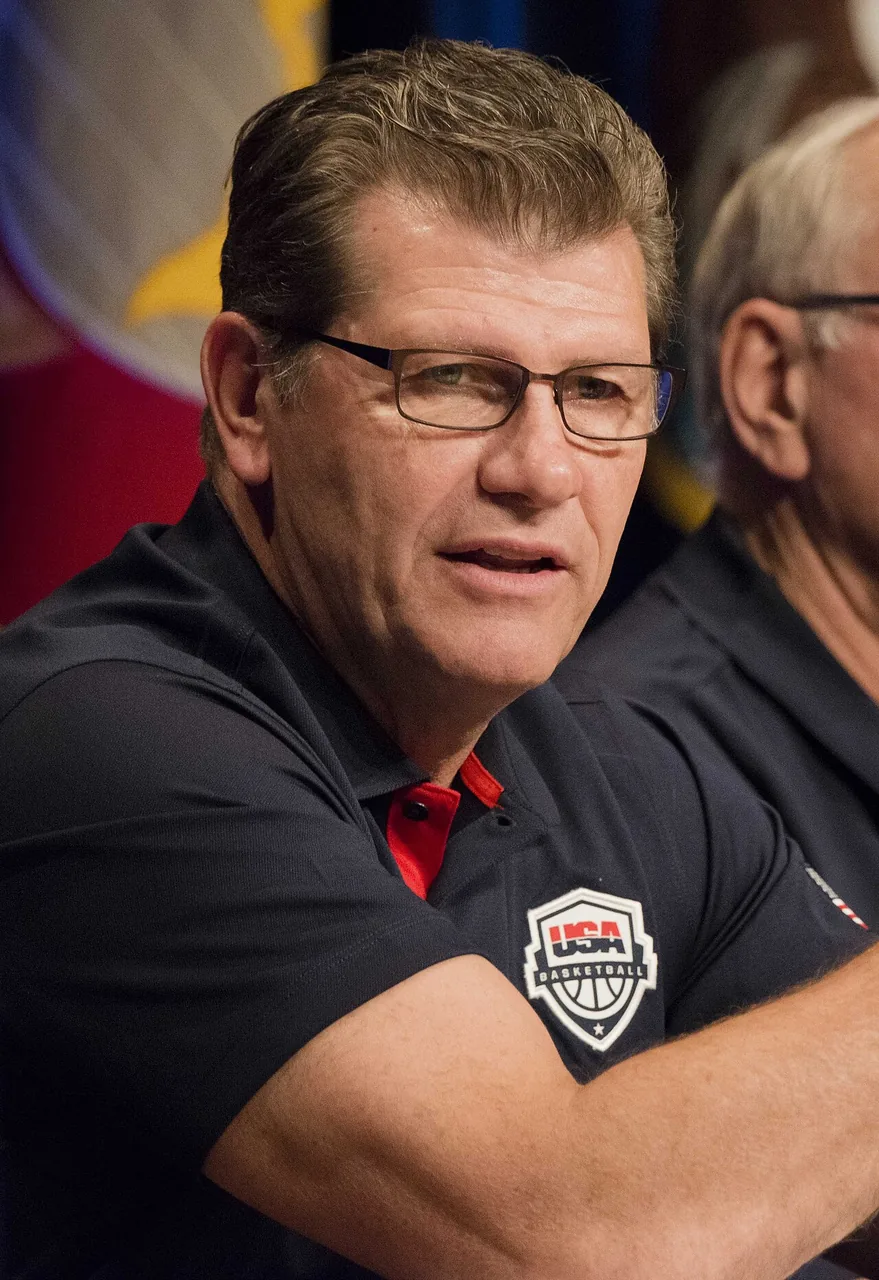
If the question says “college basketball” rather than “men's college basketball,” Geno Auriemma now supplies both headline answers. UConn's updated biography lists him at 1,288-166 through the 2025-26 season with 12 NCAA championships. Those figures are higher than the men's records of 1,202 wins for Krzyzewski and ten titles for Wooden.
| Coach | Division I program(s) | Career record | NCAA titles | Status/cutoff |
|---|---|---|---|---|
| Geno Auriemma | UConn women | 1,288-166 | 12 | Active; through 2025-26 |
| Tara VanDerveer | Idaho, Ohio State, Stanford women | 1,216-271 | 3 | Retired 2024 |
| Mike Krzyzewski | Army, Duke men | 1,202-368 | 5 | Retired 2022 |
| Pat Summitt | Tennessee women | 1,098-208 | 8 | Retired 2012 |
VanDerveer illustrates how recently the combined wins record changed. She retired in 2024 with 1,216 victories, fourteen more than Krzyzewski. Auriemma passed her in November 2024 and continued adding wins during the next two seasons. A static article that still calls Coach K the winningest coach in all Division I basketball is therefore out of date; he remains the men's leader.
Summitt supplies another essential checkpoint. Her 1,098 victories and eight NCAA titles made Tennessee the defining women's program of much of her 38-season career. Auriemma passed the wins and title standards later, but that does not erase the sequence of record holders. A record table should preserve who led, when the lead changed and which competition it counts.
The championship comparison must start in the correct era. The NCAA Division I women's tournament began in 1982. Earlier AIAW championships belong to a separate governing history and should not be silently added to an NCAA-title column. Likewise, comparing Auriemma's 12 with Wooden's ten is valid as a count of NCAA Division I championships, but it does not mean the sports had identical brackets, schedules or opportunity structures.
For the current side of the sport—not its career record book—open the women's college basketball schedule.
How to compare coaching records without mixing categories
Start with the narrow record, then broaden the conversation. Wooden is the men's NCAA-title leader. Krzyzewski is the men's career-wins leader in the NCAA coaching table. Auriemma leads the wider Division I comparison in both wins and NCAA championships through 2025-26. Those statements can all be true because each defines its field.
Six labels every coaching record needs
- 1. Gender: men's, women's or combined.
- 2. Division: Division I, all NCAA divisions or another level.
- 3. Competition: NCAA tournament, all games or conference play.
- 4. Role: head-coach wins, not assistant participation.
- 5. Adjustment: official, vacated-adjusted or on-court.
- 6. Cutoff: final career record or a specific date/season.
Championship language is especially slippery. “National titles” may refer to NCAA tournament championships, AIAW results, NAIA tournaments or historical selector claims depending on the sport and era. This article counts NCAA Division I tournament titles. Conference regular-season and tournament trophies demonstrate sustained success, but they do not belong in that title column. Nor does a Final Four appearance equal a championship.
Wins need similar discipline. A head coach gets the official result credited by the governing record, not a share of every victory earned while serving as an assistant. The NCAA can vacate results, and its infractions language specifies that affected coaching records are changed in official publications. An “on-court” total can remain useful for narrative history, provided it is labeled and never presented as the adjusted figure.
Who has the most men's NCAA basketball championships?
John Wooden, with 10 at UCLA. He won them in 1964, 1965, 1967-73 and 1975.
Who has the most men's college basketball coaching wins?
Mike Krzyzewski, with an official 1,202-368 record across Army and Duke.
For a legacy debate, add context after the records are settled: winning percentage, tournament wins, Final Fours, years at the same program, results at multiple schools, competitive depth and rules of the era. These lenses can explain why reasonable fans rank coaches differently. They should not be used to rewrite a verified number.
Finally, prefer the NCAA record hub for recognized historical tables, then use a current school biography or game notes for a moving active total. Record the page date and the source's exact terminology. Our broader editorial method is summarized on the data sources page.
Sign in with Google to join the discussion.