What size basketball does college basketball use?
Men's college basketball uses a size 7 ball, commonly sold as 29.5 inches in circumference. Women's college basketball uses a size 6 ball, commonly sold as 28.5 inches. Those inches measure the distance around the outside of the ball. They do not describe its diameter, and the number 7 does not mean seven inches. This is the quickest useful answer for someone replacing a practice ball or comparing the equipment in men's and women's NCAA games.
| Competition | Commercial size | Nominal circumference |
|---|---|---|
| NCAA men | Size 7 | 29.5 inches |
| NCAA women | Size 6 | 28.5 inches |
| NBA | Size 7 | 29.5 inches |
| WNBA | Size 6 | 28.5 inches |
The table gives familiar buying labels. A rule book does something more exact: it specifies an acceptable measurement range, weight and rebound behavior. A ball need not measure precisely the nominal number on a retail listing to meet the applicable NCAA equipment rule. Conversely, a label saying NCAA or official does not establish that a particular product has the correct size, surface or intended use for your game.
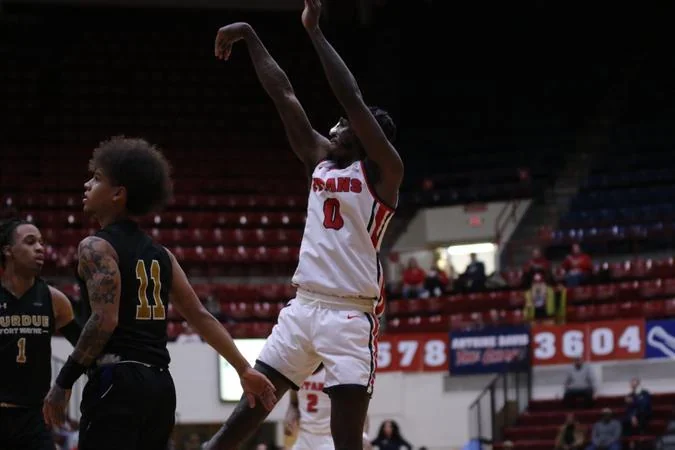
Think of a men's and women's doubleheader in the same campus arena. The venue can stay the same while the game ball changes between competitions. The relevant distinction belongs to the event, rather than to the building, the school logo or the apparent size of the athletes. A women's college player needs the women's competition ball for normal shooting work; a men's player needs the men's competition ball.
For practice, getting this basic choice right gives the player a familiar contact area when receiving a pass, setting the ball in the shooting hand and controlling a dribble. That is a practical reason to match the equipment. It is not a claim that changing size produces a predictable increase or decrease in shooting percentage. Technique, defenders and shot selection still matter, and a dimension chart cannot isolate those effects.
The same distinction helps fans interpreting television pictures. Camera angle, hand position and distance from the lens can make a basketball look larger or smaller. A broadcast frame is not a measuring instrument. Use the competition's specifications and the product's stated size rather than trying to judge the difference from a close-up of a free throw.
The NCAA rule ranges behind size 7 and size 6
The NCAA men's and women's equipment specifications allow a small band around each familiar commercial measurement. Read the circumference and weight together. A ball with an acceptable circumference can still be unsuitable if it falls outside the weight range or does not behave correctly when bounced. The current published men's and women's rule books also separate the rebound requirements.
Men's circumference, weight and rebound test
The men's rule specifies a circumference of 29.5 to 30 inches and a weight of 20 to 22 ounces. For the rebound test, the bottom of the ball starts six feet above the playing surface. The rebound is measured to the top of the ball: at least 49 inches when it lands on its least resilient spot and no more than 54 inches on its most resilient spot.
Those measuring points matter. Measuring the rebound to the bottom instead would change the observation by approximately the ball's diameter. It would not be the test described in the rule. Likewise, dropping a ball from shoulder height while giving it a downward push is not an equivalent procedure. The rule describes a drop and specified reference points, rather than a casual test of how high a hard dribble can bounce.
The men's book places responsibility for supplying a legal ball on the home team and assigns the referee the judgment of legality. It also recommends giving the visitors warm-up balls of the same type as the game ball. That detail reflects an ordinary basketball concern: a visiting guard should be able to rehearse catches, releases and dribbles with familiar equipment before facing pressure in a road game.
Women's circumference, weight and rebound test
The women's range is 28.5 to 29 inches in circumference and 18 to 20 ounces in weight. Its six-foot drop uses the same bottom-at-release and top-at-rebound measuring convention. The specified rebound range is different: at least 51 inches at the least resilient spot and no more than 56 inches at the most resilient spot.
Do not copy the men's bounce numbers into a women's checklist simply because the competitions are both NCAA basketball. The smaller nominal ball is one distinction; the separately written equipment requirements are another. A size chart that provides only 28.5 inches is useful for shopping but leaves out those rule details.
Neither test is a reason to publish one universal inflation pressure for every ball. Follow the pressure information marked on the actual product and the competition's requirements. The desired rebound depends on a properly prepared ball and the stated test, rather than on assuming every bladder, cover and floor responds identically. When officials evaluate the game ball, a fan's retail shorthand does not replace their equipment judgment.
Circumference is not diameter
A ball listed as 29.5 inches is about 9.39 inches across, not 29.5 inches across. Circumference is the length of a loop around the widest part of a sphere. Diameter is a straight line through its center from one side to the other. Confusing them turns a normal basketball into something close to the width of a doorway.
For a spherical ball, divide circumference by pi to estimate diameter. To convert an inch measurement to centimeters, multiply by 2.54. These are calculations using the nominal retail dimensions, rather than additional NCAA specifications. The real ball has seams, a textured cover and small measurement variation; do not treat a rounded calculation as a new pass-or-fail rule.
Inches, centimeters and the one-inch difference
| Nominal size | Circumference | Calculated diameter |
|---|---|---|
| Size 7 | 29.5 inches / 74.93 cm | About 9.39 inches / 23.85 cm |
| Size 6 | 28.5 inches / 72.39 cm | About 9.07 inches / 23.04 cm |
The nominal circumference difference is one inch, or 2.54 centimeters. The difference across the ball is much smaller: approximately 0.32 inches, or 0.81 centimeters. That explains how two basketballs can look very similar beside one another while still being distinct equipment choices. One inch around a circle is not one inch across it.
For someone arranging storage or checking whether a ball fits a bag, diameter is the useful estimate. For someone buying the right competition ball, circumference and the size label are normally the relevant product details. A listing offering only a diameter deserves a closer look at its specification sheet, particularly if it also uses a broad phrase such as regulation basketball.
Use consistent precision when comparing listings. A size 7 nominal circumference rounds to approximately 75 centimeters, and size 6 to approximately 72 centimeters when stated in whole centimeters. Those rounded values are not evidence that a product advertised as 74.9 centimeters is a different class. Compare measurements expressed in the same units, then check the governing range if competition compliance matters.
The numbers also keep basketball arguments proportional. A smaller nominal diameter says something about the physical object; it does not establish that women's shooting is easier or that a player can transfer a shooting percentage unchanged between ball sizes. The release, shot distance, defensive pressure and practice history belong in that discussion. Geometry answers the measurement question and stops there.
How NCAA sizes compare with the NBA and WNBA
There is no routine size jump from the men's NCAA nominal size 7 ball to the NBA's nominal size 7 ball. The comparable women's pairing is NCAA size 6 and WNBA size 6. A college player moving into the corresponding professional competition does not therefore have to switch from the women's nominal circumference to the men's, or the reverse.
Shared size is a narrower statement than shared equipment. Wilson's NBA official game-ball listing describes a genuine leather cover. NCAA rules allow leather or a composite cover that meets the equipment specifications. The cover construction, texture and product model can differ even when two listings both read 29.5 inches. A player recognizing the size can still need time with the feel of the specific game ball.
That distinction is useful when discussing a guard's move from college to professional basketball. You cannot explain an entire adjustment period by saying the professional ball is automatically bigger. Defensive length, physical pressure, spacing, role and schedule belong to separate basketball questions. The size chart only establishes which nominal class the competition uses. It does not forecast the player's shooting, passing or turnover rate.
Nor does professional branding settle the choice for a college practice session. Retail collections can include game balls, indoor/outdoor balls, display products and team-themed models. Read the actual size and material entry. An NBA logo describes an association or licensed product; it is not a substitute for the specifications of the product in your hand.
There is a further exception that catches shoppers comparing international options. A FIBA 3x3 ball combines size 6 circumference with size 7 weight. Its smaller exterior does not make it interchangeable with the usual women's full-court competition ball. The sport's format and equipment specification need to be checked together. A family buying a size 6 ball for women's college-style practice should not accidentally select a heavier 3x3 ball because the circumference looks right.
For watching the games, keep the categories separate in the same way. Our men's college basketball schedule and women's college basketball schedule follow distinct competitions. Ball size is one equipment difference, while the fixture, roster and rules context still needs to come from the event being played.
The useful comparison is therefore simple but qualified: men's NCAA and NBA match in nominal size class, as do women's NCAA and WNBA. Matching size class helps you identify the right starting point. Matching the precise game ball requires a second check of the model, intended playing surface and competition requirements.
A separate basketball size chart for younger players
A college equipment rule answers what the college competition requires. It does not answer which ball every child should use at every stage of development. For a youth chart, use a named recommendation system and identify it clearly. The NBA and USA Basketball's joint youth guidelines organize equipment and playing standards by age or school-grade segment.
What the USA Basketball age bands recommend
| Guideline segment | Boys | Girls |
|---|---|---|
| Ages 7–8 | Size 5, 27.5 inches | Size 5, 27.5 inches |
| Ages 9–11 | Size 6, 28.5 inches | Size 6, 28.5 inches |
| Ages 12–14 | Size 7, 29.5 inches | Size 6, 28.5 inches |
| Grades 9–12 | Size 7, 29.5 inches | Size 6, 28.5 inches |
This chart is the joint guideline's structure, not an NCAA age rule. It also does not cover every younger-child or specialty ball advertised online. A size 4 or mini ball can exist as a product without becoming part of this particular four-segment table. Avoid adding a universal age assignment just because a retailer has a numbered ball available.
The recommendations treat the ball as part of the playing environment. A child receiving a pass or beginning a shooting motion must control the object before learning to do it under defensive pressure. Using an adult men's college ball simply because a favorite team uses one skips the developmental purpose of the youth guidance. A recognizable campus logo does not make the larger size a better learning choice.
When a league rule takes priority over an age chart
Before buying for an organized team, ask which size the team will actually use in games. A league's published rules, a tournament handbook and a coach's equipment list may settle the practical answer. Generic retail age bands can differ from the joint NBA/USA Basketball segments; the family should identify the relevant program rather than combine all charts into an invented average.
For example, the joint chart places boys ages nine through eleven on size 6. A store might describe its size 7 range with a different starting age. That difference is a reason to read the league's rule, not proof that one basketball has been mislabeled. The store is presenting a buying recommendation, while the organized event is defining its equipment.
For unstructured practice, discuss the choice with the coach and keep the player's actual control of the ball in view. Age is a useful grouping device, but a table cannot observe an individual's strength, hand size or skill. The sensible goal is comfortable, repeatable practice in the right context, with a clear plan for the ball the player will face in games.
The joint youth guidelines are the reference for the table above. They should remain separate from the NCAA circumference and rebound ranges earlier in this guide; mixing them would turn helpful developmental advice into an inaccurate competition rule.
Checking the right ball before practice or a purchase
Start with the event and the user. For ordinary men's NCAA-style full-court practice, choose the size 7 class. For women's NCAA-style practice, choose size 6. For a youth team, begin with that team's rule or equipment instruction, using an age chart only after identifying the program. This first decision is more useful than choosing a brand and assuming every ball in its range has the same dimensions.
Next, check the selected product variant. Many retail pages place multiple sizes under a single model name. The photograph may show one sample while the size selector determines a different item. Read the selected circumference, size number and intended use before adding it to a cart. If a gift is for a women's player, a prominent NCAA badge does not compensate for accidentally selecting 29.5 inches.
Then match the surface. An indoor competition ball and a product designed for abrasive outdoor courts serve different purposes. A correct circumference does not mean an indoor cover is the sensible choice for regular driveway practice. Follow the manufacturer's playing-surface description rather than treating every composite product as identical. The aim is to buy the appropriate object for the place it will actually be used.
For an existing ball without a readable size mark, a flexible measuring tape around its widest middle can provide a useful preliminary circumference check. Keep the tape flat, avoid squeezing the cover and do not confuse the seam length with a full loop. If the result is close to a range boundary, repeat the measurement and ask the responsible coach or equipment manager rather than claiming certainty from one hurried reading.
Also inspect the ball as an object: does it remain round, are the panels intact, and does it respond consistently during ordinary handling? Read its inflation marking. Do not add pressure simply because one player wants a livelier bounce. An unusual response can make catches and dribbles feel different, while the relevant competition still has its own legal-ball requirements.
The final check is purpose. A display or autograph item may reproduce familiar colors and logos but be intended for collecting. A heavily used practice ball may have a correct label while no longer behaving like the game equipment. Size, condition and intended use should agree before the ball enters serious practice.
Keep the buying shorthand and the rule book side by side: nominal 29.5-inch size 7 for men, nominal 28.5-inch size 6 for women, followed by the precise competition specifications when a game requires them. That sequence resolves most size questions without mistaking a retail label, a youth recommendation or a calculated diameter for the whole NCAA rule.
Sign in with Google to join the discussion.