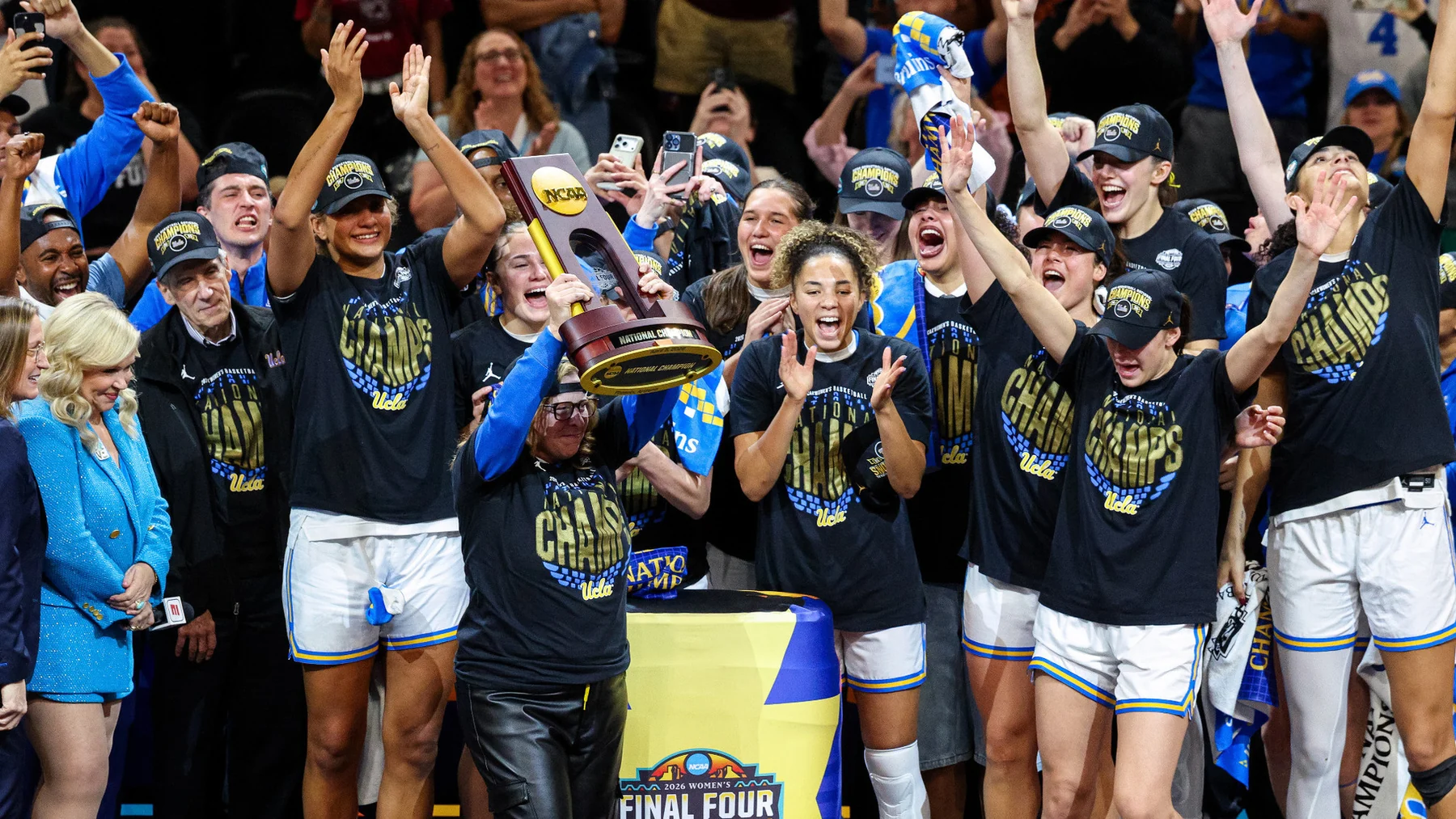
UCLA won the 2026 title: the tournament at a glance
The short answer: UCLA won the 2026 NCAA Division I women's basketball championship, beating South Carolina 79-51 in Phoenix on April 5.
The Bruins finished 37-1 and captured the program's first NCAA women's basketball title. That wording matters: UCLA also won the 1978 AIAW championship, before the NCAA began sponsoring the women's tournament in 1982.
The completed bracket covered 68 teams and 67 games. It opened with the First Four on March 18 and ended 18 days later at Mortgage Matchup Center. This recap treats every date, score and advancement as a result. It is not a prediction page, a ticket guide or a live scoreboard left frozen after Selection Sunday.
| Milestone | Date | Result |
|---|---|---|
| First Four began | March 18 | The 68-team field started play |
| Final Four semifinal | April 3 | South Carolina 62, UConn 48 |
| Final Four semifinal | April 3 | UCLA 51, Texas 44 |
| National championship | April 5 | UCLA 79, South Carolina 51 |
The bracket produced only No. 1 seeds in Phoenix: UConn, South Carolina, Texas and UCLA. It was the fifth all-No. 1-seed Final Four in the women's tournament. The symmetry ended there. South Carolina stopped UConn's unbeaten season in the first semifinal, UCLA won a low-scoring rematch with Texas in the second, and then the Bruins controlled the title game from the start. They never trailed South Carolina.
Gabriela Jaquez led UCLA with 21 points in the final, while Lauren Betts supplied 16 points and 11 rebounds and received Final Four Most Outstanding Player honors. Those individual lines explain part of the result, but the tournament's larger story was the Bruins' progression: a program that reached its first Final Four in 2025 returned one year later and finished the job.
For fans using this page as a historical checkpoint, the cleanest summary is champion, score and scope: UCLA, 79-51, in the NCAA Division I women's event. The women's college basketball schedule is the better destination for current matchups; every result below belongs to the completed 2026 tournament.
How UCLA's bracket path reached Phoenix
UCLA's championship required six wins across three locations. The Bruins hosted the opening weekend in Los Angeles, moved to Sacramento for the Sweet 16 and Elite Eight, and finished in Phoenix. Their path was not an uninterrupted series of blowouts: the margin compressed as the bracket advanced, falling to seven points in the national semifinal before widening dramatically in the final.
| Round | Opponent | UCLA result | Site stage |
|---|---|---|---|
| First round | No. 16 California Baptist | Won 96-43 | Los Angeles |
| Second round | No. 8 Oklahoma State | Won 87-68 | Los Angeles |
| Sweet 16 | No. 4 Minnesota | Won 80-56 | Sacramento |
| Elite Eight | No. 3 Duke | Won 70-58 | Sacramento |
| Final Four | No. 1 Texas | Won 51-44 | Phoenix |
| Championship | No. 1 South Carolina | Won 79-51 | Phoenix |
California Baptist absorbed the biggest margin, 53 points, in UCLA's 96-43 opener. Oklahoma State then asked a different question in the second round. Lauren Betts answered with 35 points on 15-of-19 shooting as the Bruins won 87-68. That performance was not the entire championship formula, but it demonstrated why opponents had to organize their defense around UCLA's size before worrying about its perimeter and transition options.
The regional rounds created a steadier climb. UCLA handled fourth-seeded Minnesota 80-56, then beat third-seeded Duke 70-58 for the Sacramento regional title. A 12-point Elite Eight win was comfortable on the scoreboard but much closer than the opener. It also completed the practical transition from protected home games to neutral-site elimination basketball.
Phoenix brought two fellow No. 1 seeds and opposite game shapes. UCLA scored only 51 against Texas yet advanced because it held the Longhorns to 44. Two days later, the Bruins scored 79 against South Carolina and won by 28. A champion able to survive both a possession-by-possession semifinal and a faster, more decisive final is harder to summarize than “six straight wins.” The score sequence shows adaptability as well as dominance.
Summed across the bracket, UCLA scored 463 points and allowed 320, a 143-point advantage. That aggregate is descriptive, not a universal strength rating: early-round seed gaps inflate tournament margins, while later opponents are stronger. The more revealing progression is that UCLA won at home, at a regional neutral site and at the Final Four without requiring one identical offensive script.
How four No. 1 seeds survived to the Final Four
The selection committee placed defending champion UConn first overall after a 34-0 regular season and conference-tournament run. UCLA, Texas and South Carolina received the other No. 1 seeds. All four reached Phoenix, making 2026 only the fifth women's NCAA tournament in which every top seed won its region.
Fort Worth: UConn
The Huskies beat Notre Dame 70-52 in the Elite Eight and arrived in Phoenix at 38-0, still carrying a repeat bid and an unbeaten season.
Sacramento: UCLA
The Bruins defeated Duke 70-58, returning to the Final Four after the program's first appearance one year earlier.
Fort Worth: Texas
The Longhorns removed suspense early in a 77-41 regional-final win over second-seeded Michigan.
Sacramento: South Carolina
The Gamecocks beat third-seeded TCU 78-52 and reached their sixth consecutive Final Four.
That clean regional ending should not erase the bracket's earlier movement. No. 10 Virginia eliminated No. 2 Iowa 83-75 in double overtime. No. 6 Notre Dame beat No. 2 Vanderbilt 67-64, and No. 3 Duke survived No. 2 LSU 87-85. Those results changed the opponents awaiting top seeds without dislodging the top seeds themselves.
The Elite Eight scores show why the leading line ultimately held. UConn won by 18, UCLA by 12, Texas by 36 and South Carolina by 26. None needed a one-possession finish to claim a regional trophy. Yet it would be too simple to infer that the four had identical paths. They faced different seeds, styles, sites and game states, and a margin from one region cannot normalize those variables.
There was also unusual continuity. UConn, UCLA, Texas and South Carolina had formed the 2025 Final Four, then became the second quartet in women's tournament history to return together in consecutive seasons. What changed was the pairing and outcome. UCLA had lost to UConn in its 2025 national semifinal; in 2026, UCLA drew the Texas team responsible for its only regular-season loss, while South Carolina received the unbeaten Huskies.
For bracket readers, the best interpretation is not “nothing surprising happened.” Upsets reshaped three regions, and Virginia became a double-digit seed in the second week. The stronger conclusion is that the top tier absorbed the disruption. By the end of regional play, every path still led to a No. 1 seed, creating two semifinal matchups with both familiarity and unfinished business.
The Final Four: two defensive semifinals in Phoenix
April 3 produced 110 points across two games: South Carolina 62, UConn 48, followed by UCLA 51, Texas 44. The modest totals were not empty offense alone. Both winners controlled space, forced difficult attempts and protected a lead when the opponent's season narrowed to a handful of possessions.
South Carolina ended UConn's perfect run
UConn entered Phoenix 38-0 as the defending champion. South Carolina held the Huskies to 31% shooting, won the rebounding count 47-32 and advanced 62-48. Ta'Niya Latson led the Gamecocks with 16 points and made all 10 of her free throws. UConn stars Sarah Strong and Azzi Fudd combined to shoot 7-for-31.
The loss ended UConn's 54-game winning streak and removed both the repeat bid and perfect-season possibility. South Carolina had lost the 2025 title game to UConn by 23 points; the 2026 rematch reversed control through defense rather than a scoring race. A five-point Gamecocks lead after three quarters became a 14-point final margin.
UCLA survived Texas' closing run
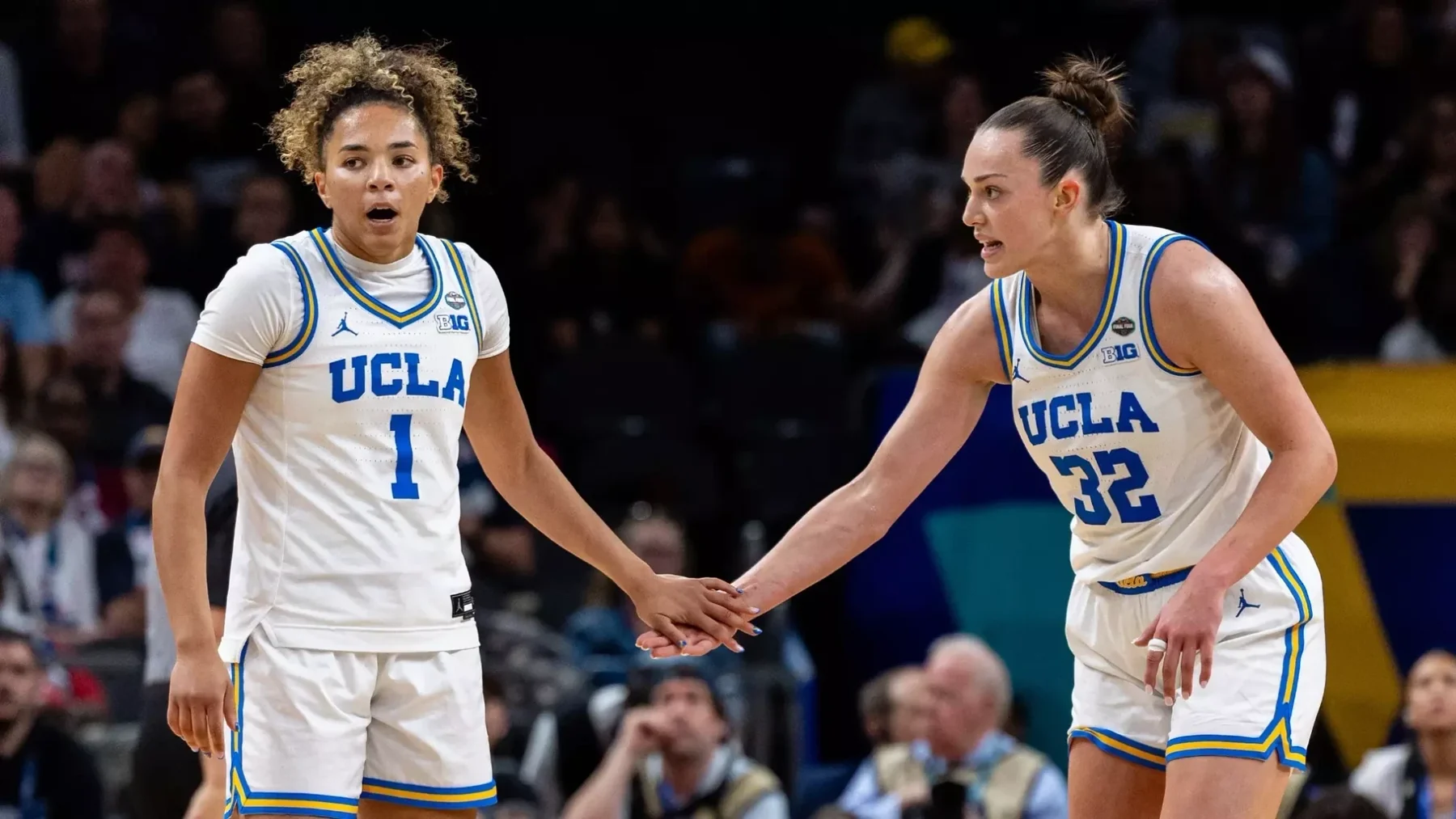
The Bruins held Texas to six first-quarter points and led 45-32 with 4:36 remaining. The Longhorns answered with a 12-2 run, trimming the gap to 47-44. With 20 seconds left, Lauren Betts recovered in transition, blocked Madison Booker's drive and secured the ball. Kiki Rice then made two free throws as UCLA closed the 51-44 win.
Betts finished with 16 points, 11 rebounds and three blocks. Booker, who had averaged more than 22 points through the tournament before the semifinal, made 3 of 23 shots and scored six. That line belongs to one game, not a verdict on her season. It illustrates how completely UCLA altered the preferred actions of an elite scorer on this particular night.
Texas had beaten UCLA 76-65 at a neutral-site Thanksgiving event, handing the Bruins their only loss of 2025-26. The rematch therefore carried a tangible matchup test rather than a generic revenge label. UCLA could not simply repeat its early-round offensive pace; it won by defending through a cold stretch and executing the largest play after Texas had created real late pressure.
Together, the semifinals selected the finalists through resistance. South Carolina broke the tournament's last unbeaten record, while UCLA avenged its only defeat. Neither result predicted the final's 28-point margin. They established which teams could survive when scoring options narrowed and every defensive rebound or transition decision carried season-ending weight.
How UCLA beat South Carolina 79-51 for the championship
UCLA removed suspense one quarter at a time. The Bruins scored the game's first points, led 21-10 after 10 minutes and never trailed. They reached halftime ahead 36-23, then produced a 25-9 third quarter that made the score 61-32. By the fourth, the championship question had shifted from who would win to how emphatically UCLA would complete its season.
21-10
After the first quarter
36-23
At halftime
61-32
After the third quarter
The first quarter established the terms. UCLA made four of its first five shots while South Carolina made one of its first five. The Gamecocks briefly cut into the early margin, but the Bruins finished the period on an 8-0 run. That mattered after Friday's semifinals because neither finalist had reached 63 points; UCLA surpassed its entire 20-point first half against Texas during the opening quarter of the title game.
South Carolina pressured UCLA into a four-possession turnover stretch during the second quarter, yet the Bruins still added to their lead. Every UCLA starter had at least five points by halftime. The distribution prevented the Gamecocks from solving the game with one matchup adjustment, even though center Lauren Betts remained the interior reference point.
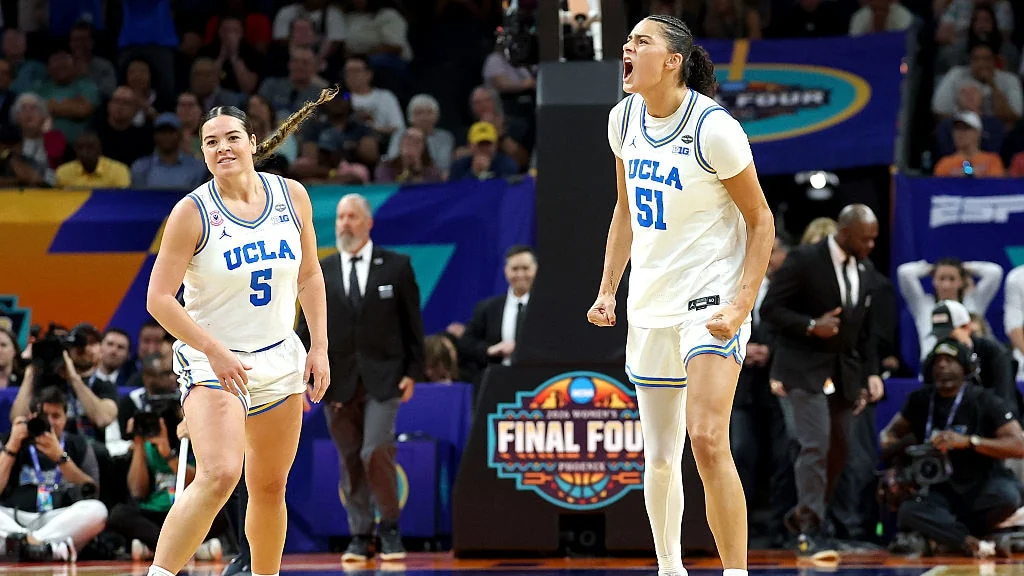
Gabriela Jaquez supplied the leading line: 21 points, 10 rebounds and five assists. She shot 8-for-14 and made two of four three-point attempts. Betts recorded 16 points and 11 rebounds, anchoring the defense two days after her decisive semifinal block. Five Bruins scored in double figures, an important detail in a final where all five starters had already contributed before intermission.
Betts received Final Four Most Outstanding Player honors. Jaquez and Kiki Rice joined her on the all-tournament team, alongside South Carolina's Tessa Johnson and Ta'Niya Latson. The award recognizes performance during championship weekend; it is not the same thing as a full-tournament scoring title or a season-long player award.
The 79-51 finish gave UCLA a 28-point title-game margin and a 37-1 record. South Carolina finished 36-4 after reaching a third straight championship game. A final can become lopsided without invalidating the runner-up's path: the Gamecocks had eliminated unbeaten UConn 48 hours earlier. On Sunday, however, UCLA's early shooting, balanced scoring and sustained defensive pressure gave South Carolina no comparable route back.
What the 2026 tournament changed in the record book
The most durable change is simple: UCLA now appears in the NCAA Division I women's championship table. The Bruins' 37-1 team, coached by Cori Close, is listed beside a 79-51 victory over South Carolina in Phoenix. It is UCLA's first championship in the NCAA event and the completion of a rise from first NCAA Final Four in 2025 to first NCAA title in 2026.
Keep the historical labels attached
UCLA has two women's basketball national championships across two governance eras: the 1978 AIAW title and the 2026 NCAA title. Calling 2026 the program's first NCAA championship is accurate. Calling it the program's first national championship without qualification would erase the earlier AIAW achievement.
The final added a tournament-scale mark as well. UCLA's 28-point margin was the third-largest in the history of the NCAA women's championship game. “Third-largest” matters: the rout approached the event record but did not set it. The correct historical description honors the scale of the result without promoting a near-record into a record.
At the program and conference levels, the season produced different entries. UCLA's 37 victories were the most ever by a Big Ten women's team, according to the school, and its 31-game winning streak was a program best. The Bruins also went 18-0 in Big Ten play. Those are season and conference achievements, not NCAA tournament records, even though the six tournament victories completed each one.
The bracket changed the stories of the other three top seeds too. UConn's 54-game streak and undefeated repeat attempt ended in the semifinal. Texas returned to the Final Four and pushed the eventual champion into its lowest-scoring game of the run. South Carolina reached a third consecutive final and eliminated the defending champion before finishing runner-up for a second straight season. A champion-centered recap should still retain those outcomes because they explain the difficulty and sequence of the final weekend.
Finally, the tournament reached well beyond the box score. AP reported that the UCLA-South Carolina final averaged 9.9 million viewers on ESPN and ABC, the third-largest audience for a women's championship game since ESPN began televising the event in 1996. That is a media-era comparison, not an all-time attendance or popularity ranking, but it records the scale of attention surrounding UCLA's breakthrough.
This page should now function as a fixed historical account: the completed bracket, the scores that mattered, the four Phoenix teams and the champion. For games still being played, move to the college basketball schedule today. For 2026, the final line will not change: UCLA beat South Carolina 79-51 and became an NCAA women's basketball champion.
Sign in with Google to join the discussion.