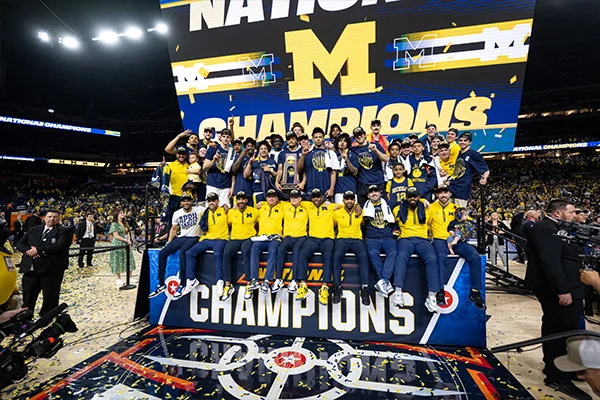
Michigan won the 2026 national title: tournament at a glance
Michigan won the 2026 NCAA Division I men's basketball championship, defeating UConn 69-63 at Lucas Oil Stadium in Indianapolis on April 6.
The Wolverines finished 37-3, secured the program's second NCAA title and ended a championship drought that had lasted since 1989.
The result completed a 68-team tournament that began with the First Four in Dayton on March 17 and 18. Michigan entered the main bracket as the No. 1 seed in the Midwest Region. It won six games, scored at least 90 points in the first five, then had to win the championship with defense, free throws and late-game control when UConn dragged the pace and score downward.
| Tournament milestone | Result | Date and site |
|---|---|---|
| Final Four semifinal | UConn 71, Illinois 62 | April 4, Indianapolis |
| Final Four semifinal | Michigan 91, Arizona 73 | April 4, Indianapolis |
| National championship | Michigan 69, UConn 63 | April 6, Indianapolis |
Elliot Cadeau supplied the title game's clearest individual line. The Michigan guard scored 19 points, led both teams and received NCAA Tournament Most Outstanding Player honors. Michigan made only two three-pointers, but it converted 25 of 28 free throws and held UConn to 30.9% shooting. The champion therefore proved it could win a game that looked nothing like the five double-digit, 90-point victories that delivered it to Monday night.
This is a finished-tournament recap, not a frozen prediction bracket. Every score below is final, and “championship” refers to the 2026 NCAA Division I men's event. Fans looking for upcoming games should use the men's college basketball schedule; the purpose here is to preserve how Michigan moved through March and why the final demanded a different version of the Wolverines.
Michigan's six-game path through the Midwest Region
Michigan's route covered six opponents, three cities and two very different versions of winning basketball. The Wolverines opened in St. Louis, claimed the Midwest Region in Chicago and completed the Final Four in Indianapolis. They never faced a seed lower than No. 6 after the opening weekend, yet every victory before the final came by at least 13 points.
| Round | Opponent | Result | Site stage |
|---|---|---|---|
| First round | No. 16 Howard | Won 101-80 | St. Louis |
| Second round | No. 9 Saint Louis | Won 95-72 | St. Louis |
| Sweet 16 | No. 4 Alabama | Won 90-77 | Chicago |
| Elite Eight | No. 6 Tennessee | Won 95-62 | Chicago |
| Final Four | No. 1 Arizona | Won 91-73 | Indianapolis |
| Championship | No. 2 UConn | Won 69-63 | Indianapolis |
The Howard opener established the offensive ceiling: Michigan shot 67.3% from the field and scored 101. Saint Louis lowered that accuracy but not the flow; the Wolverines recorded 20 assists and made 11 threes in a 95-72 win. Alabama then became the only pre-final opponent to keep the margin below 18, but Michigan still scored 90 while making 13 of 27 from deep.
The Midwest final was the separation game. Tennessee led 16-14 before Michigan launched a 21-0 run. Yaxel Lendeborg finished with 27 points, Elliot Cadeau had 10 assists and the Wolverines won 95-62. Their size did not merely create half-court post touches: stops and rebounds released a transition attack that turned a close first half into a regional-title rout.
Arizona presented another No. 1 seed and still could not disrupt the pattern. Michigan won 91-73, its fifth straight game with at least 90 points, 15 assists and 10 three-pointers. Then the pattern broke. Against UConn, the Wolverines shot 38.2%, had only seven assists and made two threes. They nevertheless defended well enough and reached the foul line often enough to finish the path.
That contrast is why the complete route matters. Aggregate margin can make a champion look inevitable after the fact, but a single-elimination run tests different solutions. Michigan's first five wins rewarded spacing, passing and early runs. The sixth rewarded patience when those advantages disappeared.
The bracket results that reshaped the Final Four
The Final Four contained two No. 1 seeds, a No. 2 and a No. 3: Michigan, Arizona, UConn and Illinois. That looks orderly in a seed line, but the routes were not. The defending champion fell on the opening weekend, a First Four team reached the Sweet 16, and the East regional final turned on one shot with less than a second remaining.
East: No. 2 UConn
UConn erased a 19-point deficit against overall No. 1 Duke and won 73-72 when Indianapolis native Braylon Mullins hit a long game-winner with 0.4 seconds left.
South: No. 3 Illinois
Illinois beat Houston 65-55 in the Sweet 16, then closed the regional final on an 8-0 run to defeat No. 9 Iowa 71-59.
West: No. 1 Arizona
The Wildcats scored 109 against Arkansas, then controlled No. 2 Purdue 79-64 to return to the Final Four for the first time in 25 years.
Midwest: No. 1 Michigan
Michigan followed a 90-77 Sweet 16 win over Alabama by beating Tennessee 95-62, the largest regional-final margin of the four.
Iowa created the most visible early bracket break. The No. 9 Hawkeyes ended Florida's attempt to repeat as champion, then reached the Elite Eight before Illinois pulled away. Texas offered another kind of run: the No. 11 Longhorns started in Dayton, beat NC State, Gonzaga and Arkansas, and made the Sweet 16 before Purdue stopped them 79-77. Neither became a Final Four outsider, but both altered which favorites had to play each other.
UConn's escape changed the tournament's championship logic. Duke had been the overall No. 1 seed and led by 19, yet one possession placed the Huskies in Indianapolis for the third time in four years. Illinois, meanwhile, reached its first Final Four since 2005 by winning with size and defense rather than matching Arizona or Michigan's 90-point pace.
The bracket therefore narrowed toward strong seeds without becoming predictable. Seed explains where a team began, not how it advanced. By Indianapolis, the surviving quartet represented a buzzer-beating comeback, a defensive Big Ten regional champion and two explosive No. 1 seeds. Those distinct paths set up semifinals that were more tactically varied than the numbers beside the school names suggested.
Final Four: UConn survived Illinois and Michigan overwhelmed Arizona
The April 4 semifinals produced the same destination through opposite games. UConn had to answer Illinois twice in the final 10 minutes. Michigan seized Arizona almost immediately and never allowed the anticipated No. 1-seed showdown to become close.
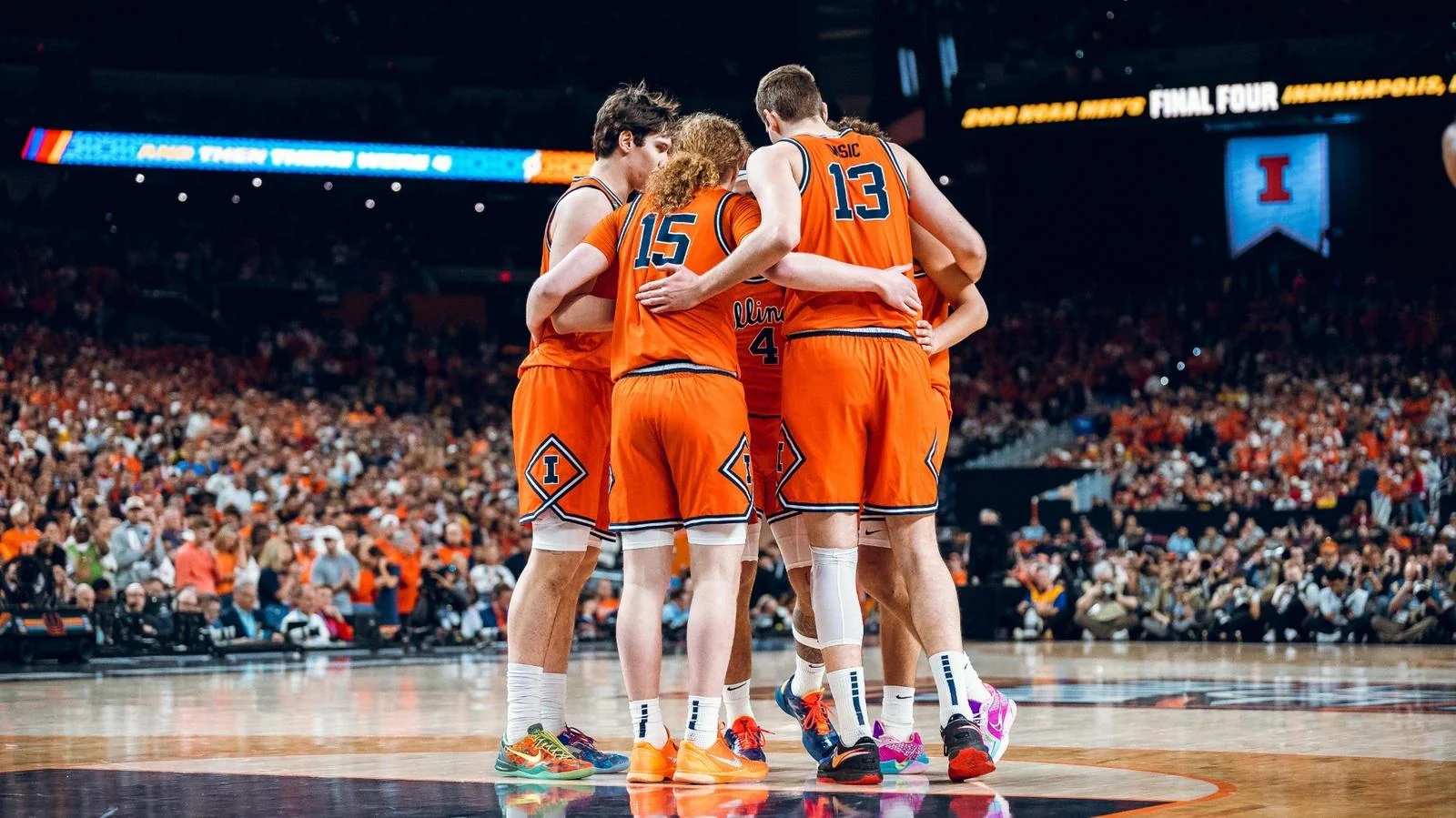
UConn 71, Illinois 62
UConn led 37-29 at halftime and extended the advantage to 57-43. Illinois then generated a 10-0 run, largely at the free-throw line, and pulled within four. The Huskies answered the late pressure, including a Braylon Mullins three, and closed at the line.
Tarris Reed Jr. gave UConn 17 points and 11 rebounds, while Mullins scored 15. Illinois freshman Keaton Wagler finished with 20 points and eight rebounds. The key contrast was perimeter conversion: Illinois went 6-for-26 from three, while UConn made 12 threes despite two long field-goal droughts. The Huskies did not play a smooth offensive game; they made enough high-value shots to survive the stretches when neither team could score.
Michigan 91, Arizona 73
Michigan built a double-digit lead in the first six minutes and reached halftime ahead 48-32. Aday Mara scored a career-high 26 points with nine rebounds as the Wolverines became the first team to score 90 in five games during one NCAA tournament.
Arizona arrived with a top-level defense and a roster built to compete with Michigan's size. It still struggled to create clean first-half offense, producing only two assists against nine turnovers before halftime. Michigan converted those disruptions into early attacks, paint finishes and nine dunks across the game. A semifinal billed as an even collision instead became the fifth consecutive double-digit Wolverines win.
There was one important constraint on the title-game outlook. Yaxel Lendeborg played only 14 minutes after landing on an opponent's foot; AP reported an ankle roll and knee sprain. He still scored 11, and Michigan's depth carried the night, but the injury created uncertainty that the final score alone could not show.
The finalists therefore arrived by different tests. UConn had practiced surviving narrow margins since the East regional final. Michigan had spent three weekends forcing opponents out of their preferred pace. Monday's championship would ask which identity could impose itself when neither semifinal script repeated cleanly.
How Michigan beat UConn 69-63 in the championship game
The final was not another Michigan track meet. UConn forced the Wolverines to play through misses, offensive-rebound scrambles and long half-court possessions. Michigan responded by protecting the paint, drawing enough fouls to live at the line and trusting Elliot Cadeau to organize the decisive second-half stretch.
30.9%
UConn field-goal shooting
25-28
Michigan free throws
36-22
Michigan paint-point edge
Michigan led 33-29 at halftime despite missing all eight of its threes. Cadeau and Morez Johnson Jr. scored the Wolverines' first 15 points, keeping the offense attached to the rim and foul line. The game was tied eight times and changed leaders six times in the first half, but UConn never led after intermission.
Cadeau created the first meaningful separation. His layup, three-point play and Michigan's first made three helped push the lead to 48-37 with 12:56 remaining. UConn cut it back to five. Michigan then used a lob to Aday Mara and six straight Yaxel Lendeborg points to rebuild control. Trey McKenney's three with 1:50 left made it 65-56; it was only Michigan's second of the night.
UConn's offensive rebounding kept the game alive. The Huskies collected 22 on that end and scored 19 second-chance points. Tarris Reed Jr. had 13 points and 14 rebounds, while Alex Karaban led UConn with 17. Yet extra possessions could not erase 21-for-68 shooting. Michigan contested well enough to hold a fourth straight opponent to its season-low field-goal percentage.
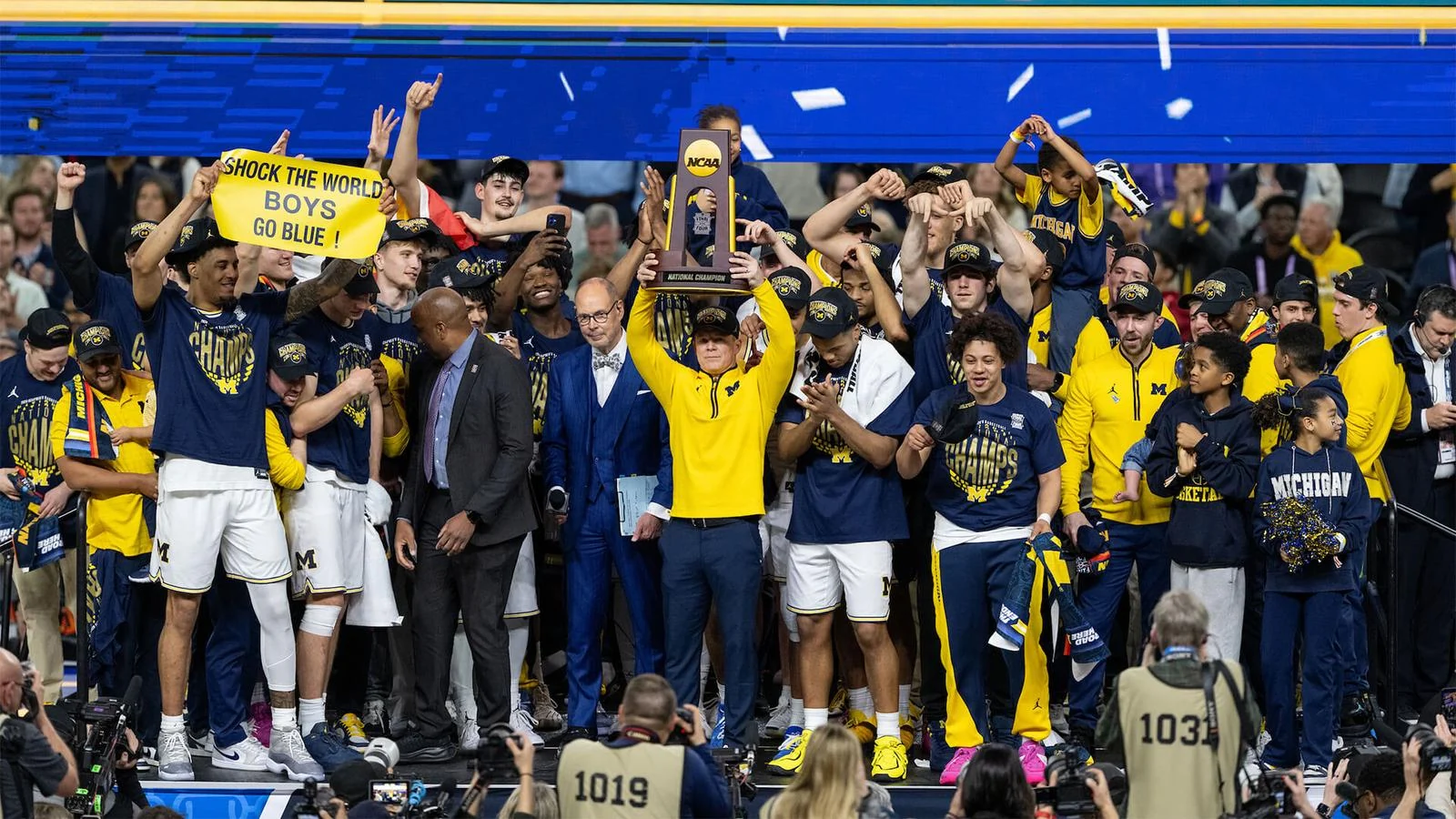
The final minute still required execution. Solo Ball's banked three cut the margin to four with 37 seconds left. After Michigan missed two free throws, Karaban had a chance to make it a one-point game but missed. McKenney then made the last two free throws. Cadeau finished with 19 points; Lendeborg had 13; Johnson recorded 12 points and 10 rebounds.
Michigan did not win every statistical contest. It lost the offensive glass badly and shot 13.3% from three. It won the categories that survived the game's shape: 36 paint points, 25 made free throws and six blocks while keeping UConn below one point per field-goal attempt. That adaptability, more than the earlier 90-point streak, decided the championship.
What Michigan's 2026 championship changed in the record book
The NCAA championship table now has a second Michigan entry. The 2026 Wolverines join the 1989 team, which beat Seton Hall 80-79 in overtime. Dusty May's group ended the 37-year gap with a different kind of final, holding UConn to 63 points and becoming the first Michigan team since Glen Rice's champions to leave the tournament with the trophy.
Four records, four distinct scopes
- NCAA history: Michigan won its second Division I men's tournament title.
- Program history: 37 victories were the most in a Michigan season.
- Conference history: 37 wins tied 2004-05 Illinois for the Big Ten single-season record.
- Poll history: Michigan received all 57 first-place votes in the final AP Top 25.
The conference consequence was just as clear. Michigan delivered the Big Ten's first NCAA men's basketball championship since Michigan State in 2000. That drought had survived multiple title-game appearances and deep tournament runs. In 2026, the league also placed a record six teams in the Sweet 16 and tied the tournament record with four Elite Eight teams, so Michigan's title capped broad postseason strength rather than standing alone.
UConn's historical line changed too. The Huskies entered the final 6-0 in NCAA championship games and seeking a third title in four seasons. Michigan handed UConn its first title-game loss. That result does not diminish six championships or the modern run under Dan Hurley; it marks the first exception to a previously perfect final-stage record.
The final AP poll placed Michigan first unanimously, with UConn second, Arizona third, Duke fourth and Illinois fifth. That ranking is a useful season-ending snapshot, but it should not be confused with the mechanism that awarded the championship. Michigan is champion because it won six tournament games, not because voters placed it first afterward.
The most durable summary is therefore precise: second NCAA title, first since 1989, 37 wins and the Big Ten's first men's champion since 2000. The tournament's live pages and ticket listings have expired as practical tools, but those records remain. Readers looking for games now should move to the college basketball schedule today; this recap preserves the completed 2026 bracket.
Sign in with Google to join the discussion.